August 2026 Rohingya Report: Land Confiscation, Forced Displacement and Abuses in Rakhine State
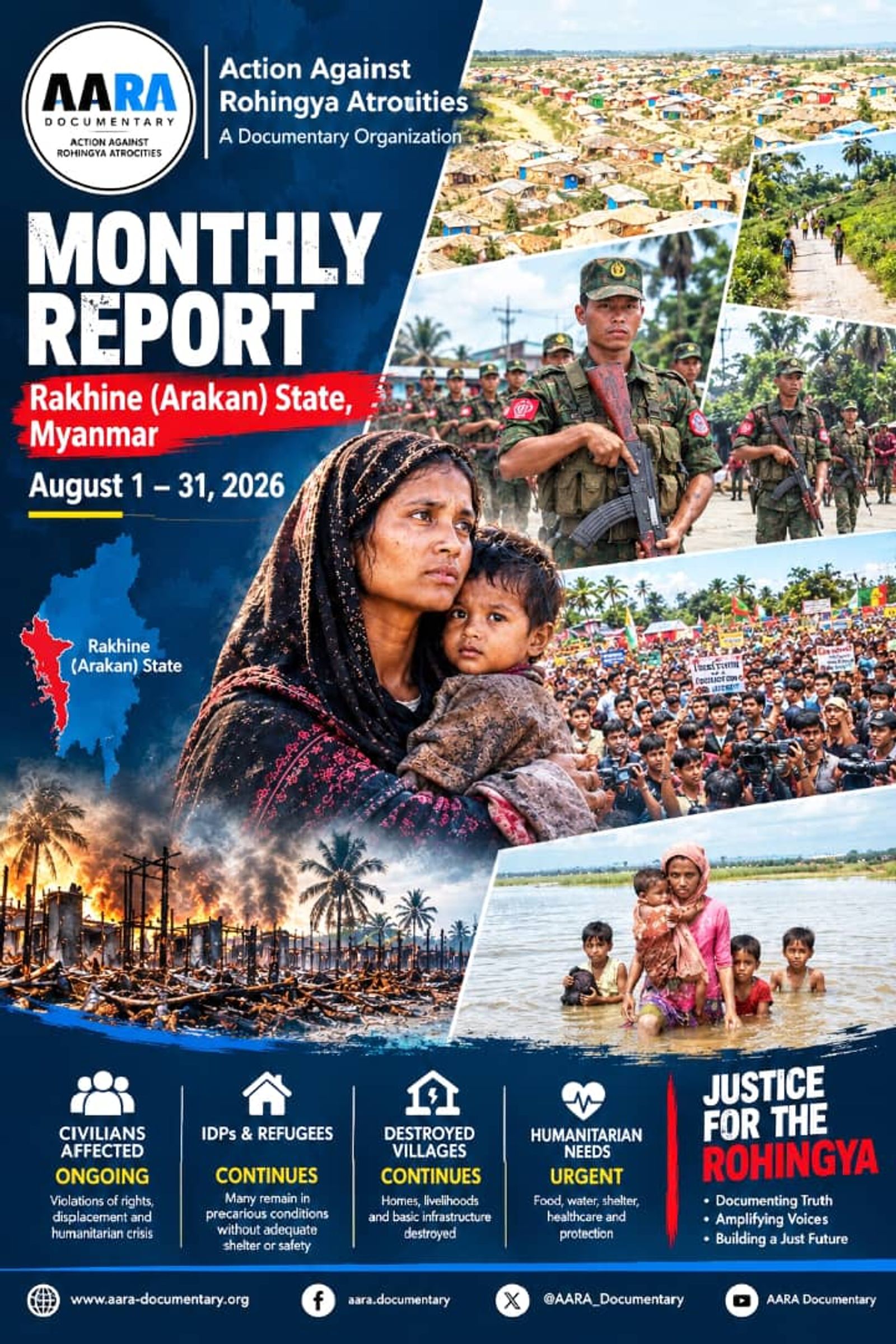
AARA’s August 2026 report documents escalating abuses, land confiscation, forced displacement, and growing protection concerns facing Rohingya civilians in Rakhine State.
EXECUTIVE SUMMARY
August 2026 marked a significant escalation in human rights violations and protection concerns affecting Rohingya civilians in Rakhine State. The reporting period witnessed intensifying restrictions, systematic land confiscations, forced displacement, and alleged atrocities by the Arakan Army (AA) against Rohingya communities, alongside continued documentation of abuses by UN mechanisms.
Key developments include:
- OHCHR Documentation: Approximately 2,000 acres of Rohingya land seized in AA-controlled areas, confirmed by satellite imagery.
- Demographic Engineering: Systematic construction of Rakhine settlements on former Rohingya village sites in Maungdaw and Buthidaung Townships, affecting nearly 40 villages and displacing approximately 100,000 Rohingya.
- AA/ULA Restrictions: Mandatory guest registration orders, land transaction bans, discriminatory internet access, and escalating movement restrictions.
- International Documentation: UNOHCHR and IIMM reports documenting AA abuses including torture, sexual violence, forced labor, child exploitation, and the Buthidaung massacre (at least 170 killed in May 2024).
- Legal Developments: ICJ judgment expected in October 2026 in The Gambia's genocide case against Myanmar.
- Humanitarian Crisis: Diarrhea outbreak in Sittwe camps resulting in 6 deaths and 229 infections; continued arbitrary arrests and secret detention of Rohingya.
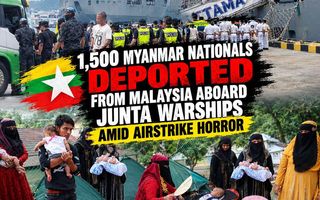
- Forced Repatriation Concerns: Malaysia's planned repatriation of 1,476 Myanmar nationals (including Rohingya) despite international warnings.
Note on Verification: Due to restricted independent access to conflict-affected areas, many incidents documented herein require further independent investigation and corroboration.
1. LAND CONFISCATION & PROPERTY RIGHTS
1.1 OHCHR Documentation of Mass Land Seizures
On August 25, 2026, the UN Office of the High Commissioner for Human Rights (OHCHR) released its annual report covering June 1, 2025, to May 31, 2026, documenting extensive land confiscation in AA-controlled areas.
Key Findings:
- Approximately 2,000 acres of Rohingya land seized, confirmed through satellite imagery analysis.
- Seized lands are being reallocated to non-Rohingya communities.
- Systematic confiscation extends to homes, agricultural land, and properties.
1.2 AA/ULA Settlement Construction on Rohingya Village Sites
Baguna Village, Maungdaw Township (Southern Region)
According to local Rohingya residents, AA/ULA forces are constructing Rakhine settlement homes on the site of Bagunara Village, a former Rohingya village burned during the 2017 military crackdown.
Documented Details:
- Construction began in the last week of August 2026.
- Bulldozers cleared the old market area.
- Homes are being built on 20ft x 40ft plots.
- Rakhine families are being brought from southern Rakhine and Ramree Township.
- Approximately 2,000 Rakhine families are currently housed at the Hlapho Khaung Relief Camp awaiting settlement.
Land Distribution to Rakhine Settlers:
- 2 acres of farmland per family.
- Tractors and farming equipment provided.
- Agricultural support for new settlements.
1.3 Systematic Confiscation and Control
Maungdaw District (August 8, 2026 Meeting):
- AA/ULA declared all farmland historically owned by Rohingya as ULA property.
- Rohingya granted only "usage rights," not ownership.
- Permission and tax payments required for cultivation.
- Policy applies to both current residents and Rohingya displaced abroad.
Ongoing Measures:
- Prohibitions on buying/selling residential or agricultural land.
- Bans on fencing and residential expansion.
- Systematic registration of Rohingya-owned land, shrimp farms, and properties.
- Properties of displaced Rohingya classified as "ownerless" and confiscated as AA treasury assets.
- Family members denied claim rights.
1.4 Forced Displacement and Demographic Engineering
Buthidaung Township:
- Approximately 100,000 Rohingya displaced since AA takeover.
- Families forcibly relocated to overcrowded sites east of the Mayu River.
- 20ft x 40ft plots provided with no building assistance.
- No access to construction materials from nearby forests.
- Those unable to afford materials cannot build shelters.
- Estimated 99% of displaced face hunger and poverty.
- Refusal to relocate met with threats of arrest.
- Original farmland permanently lost.
Affected Villages (Approximately 40 Villages):
| Township | Affected Villages |
| Maungdaw | Pyin Shey, Maung Kyi Taung, Kyeit Mauk Taung, Da Pru Chaung, Pa Lwe Taung, Aung Lan Pin, Tha Yae Kone Tan, Maung Hla Ma, Kone Tan, Nga Kyaunt Tauk, Mee Kyaung Gaung Htwe, Laung Chaung, Inn Hnget Thay, Pya Pin Yin, Htan Shauk Khan, Yay Nyo Taung, Kone Taing, Hta Kay Pin Ma Nu, Mee Kyaung Zay, Fay Tar Ali, Darpine Saya, Myit Nar, Ngar Yant Chaung, Kyee Noke Thee |
| Buthidaung | Maung Gyi Taung, Tat Min Chaung, Khein Chaung/Tha Mee Kha Li |
Rakhine Settlements Already Established:
- Maung Gyi Taung: Hundreds of Rakhine families settled since early May.
- Tat Min Chaung: Rakhine families settled.
- Khein Chaung/Tha Mee Kha Li: Rakhine families settled.
- Aung Lan Pin: Rakhine villagers expanded into adjacent Rohingya farmland.
- Laung Chaung: Nearby Rakhine villagers have taken over the area.
1.5 Analysis: Demographic Engineering Strategy
Local sources report that AA/ULA is implementing the "Rakkhita Path" (Rakhine nationalist policy) to ensure Rakhine become the demographic majority in every township and village tract through:
- Destruction of Rohingya-majority villages and townships.
- Pressure on Rohingya populations to relocate.
- Expulsion of Rohingya residents.
- Repopulation of vacant Rohingya villages, farmland, and homes with Rakhine settlers from other areas.
2. AA/ULA GOVERNANCE & RESTRICTIONS
2.1 Mandatory Guest Registration Order
Date: August 25, 2026
AA/ULA announced via loudspeaker that Rohingya residents in northern Maungdaw Township must report to authorities if they wish to stay overnight at another house, within the same village or in a different village, whether as a guest or due to emergency.
Key Elements:
- Failure to comply will result in "severe action."
- Increased security patrols with squads of approximately 18 troops sweeping Rohingya villages day and night.
- Advance reporting required for visits to other villages or receiving outside guests.
- Guest lists must be submitted to local AA administrative bodies.
2.2 Discriminatory Internet Access
Buthidaung Township:
- Starlink internet available only to ethnic Rakhine.
- Rohingya must pay ethnic Rakhine users 3,000 kyat per hour to access Starlink.
- Rohingya affairs offices (Juri Office, Muslim Affairs offices) have no direct Starlink access.
2.3 Land Transaction and Construction Bans
Date: August 21, 2026
AA/ULA authorities prohibited Rohingya in Maungdaw Township from:
- Buying or selling residential or agricultural land.
- Erecting fencing.
- Expanding residential buildings.
- Violations subject to "legal action."
3. ARBITRARY ARRESTS & DETENTION
3.1 Overview
Rohingya residents in Sittwe and Maungdaw Townships continue to face heightened risk of arrest, detention, extortion, and abuse by forces affiliated with Myanmar military authorities and AA forces.
Pattern of Arrests:
- Police, military personnel, Military Security Affairs, and Border Guard Police involved.
- Allegations include human trafficking or links to Arakan Army (AA).
- Arrests based on name matching or similarity to suspect lists.
- Some detainees have no connection to allegations.
- Detainees taken to military/Military Security Affairs facilities outside normal police procedures.
- Families receive little or no information about whereabouts, legal status, or condition.
Scale:
- Human rights groups report hundreds of civilians held in secret military detention facilities.
- OHCHR reports deaths in detention.
3.2 Newly Documented Cases (August 2026)
Case 1: Nur Saba (Also known as U Baya Saya)
- Age: 40 years old
- Village: Latha Village, Latha Ward, Maungdaw Township
- Medical Condition: Diabetes
- Circumstances: Traveled to Bangladesh for medical treatment; returned to village.
- Date of Arrest: August 14, 2026, approximately 10:00 PM
- Details: Nearly 100 AA troops arrived at the village, blindfolded him, and took him from his home.
- Status: No information received since arrest.
Case 2: Mamot Rofit (Also known as U Raw Sheet)
- Age: 35 years old
- Village: Latha Village, Latha Ward, Maungdaw Township
- Date of Arrest: Approximately four months ago (around April/May 2026)
- Status: No information received about condition or whereabouts.
3.3 Previously Documented Cases (Requiring Verification)
| Name | Age | Location | Circumstances |
| INGO Employee | Unknown | Bawdiph-2 IDP Camp, Sittwe | Arrested July 23; family uninformed |
| Abdul Hamid | 70 | Thet Kay Pyin Village | Arrested based on name match; held over a week |
| Maung Kyaw Khin | Unknown | Maung Thi Nya IDP Camp | Arrested based on name similarity; no information after a week |
3.4 Testimony from Former Detainee
A person released from AA detention stated:
"The AA's treatment of Rohingya detainees exceeds even the notorious Myanmar military's pattern of crimes against humanity. They show complete inhumanity and cruelty toward Rohingya, forcing them to do hard labor, fabricating pretexts to arrest and extort money, committing various atrocities, and engaging in systematic oppression."
3.5 Analysis
A Rakhine affairs observer commented:
"The AA has overthrown one dictatorship only to become another dictatorship themselves."
4. HUMAN RIGHTS VIOLATIONS & ABUSES
4.1 UN Office of the High Commissioner for Human Rights (OHCHR) Report
Date: August 24, 2026
Coverage Period: June 2025 – May 2026
The OHCHR report documents systematic abuses by AA forces against Rohingya populations:
Documented AA Abuses:
- Arbitrary Arrests: Widespread detention without legal process.
- Torture Methods: Beatings with bamboo, burning with matches, hanging upside down with bodies spun until loss of consciousness, application of chili to genitals, fingernail removal.
- Sexual and Gender-Based Violence: Rape and other forms of sexual violence against Rohingya women.
- Forced Labor: 50 men per village required without pay or food provision (April 2026).
- Forced Recruitment: Mandatory military conscription; attempts to escape face detention.
- Child Exploitation: Children as young as six forced to clear forests, build structures, and perform manual labor.
- Destruction of Villages and Religious Sites: Mosques and Rohingya villages destroyed.
- Deaths in Detention: Confirmed reports of detainees dying during captivity.
Findings on Myanmar Military:
- Continued aerial and artillery attacks impacting civilians and civilian infrastructure.
- Significant increase in attacks on civilians, schools, hospitals, markets, and religious buildings since 2025.
- Forced displacement of Rakhine civilians in Sittwe Township.
- Denial or restriction of humanitarian aid leading to deaths from starvation.
4.2 Independent Investigative Mechanism for Myanmar (IIMM) Annual Report
Date: August 11, 2026
Coverage Period: July 1, 2025 – June 30, 2026
- Key Findings:
- Allegations Against Myanmar Military: Killings, sexual violence, forced displacement, arbitrary detention.
- Allegations Against AA: Sexual and gender-based violence against Rohingya women, rape, killings in Kyauktaw Township, forced recruitment and use of children under 15.
- Destruction of Mosques: Documented destruction and repurposing of mosque lands for non-Rohingya settlements, increasing significantly from 2024 onward.
- Secondary Displacement: Rohingya displaced into Bangladesh after AA cleared areas where they resided.
- Ethnically/Religiously Derogatory Language: Targeting of Rohingya accompanied by discriminatory language.
- Repatriation Implications: Return prospects tied to security, access, recovery of homes, land, religious sites, and properties.
Note: IIMM's documentation of allegations against both parties underscores that international investigations target perpetrators regardless of affiliation.
4.3 Human Rights Watch: Buthidaung Massacre Documentation
Report Date: May 19, 2026
Human Rights Watch documented evidence that at least 170 Rohingya—men, women, and children, were killed in a massacre in Buthidaung Township in May 2024, allegedly carried out by the AA.
Status: AA has denied the allegations.
4.4 Forced Labor and Recruitment
Documented Practices:
- 50 men per village required for labor without pay or food provision (April 2026).
- Children as young as six forced into manual labor.
- Forced military recruitment across Arakan (Rakhine).
- Attempts to escape conscription result in detention and routine ill-treatment.
4.5 Landmine Injuries and Extrajudicial Killings
OHCHR reports document ongoing violence including:
- Landmine injuries.
- Extrajudicial killings.
- Torture as part of detention practices.
5. CONFLICT & DISPLACEMENT
5.1 Military Situation
Airstrikes:
- Date: August 4, 2026
- Location: Mrauk-U City
- Details: Approximately six fighter aircraft involved; at least seven bombs dropped.
- Target: Light Infantry Battalion No. 540 reported as main target.
- Scale: Eight Air Force jets carried out over 30 airstrikes on LIB 540 and Police Battalion 31 outposts.
- Casualties: Four civilians reported injured.
- Impact: Residents sought shelter; increased fear and anxiety among civilians.
Conflict Dynamics:
- AA has captured 14 of Rakhine State's 17 townships since launching 2024 offensive.
- AA pushing toward Sittwe and Kyaukphyu.
- Myanmar junta deployed approximately 2,000 troop reinforcements from Light Infantry Division 55 to Magway Region.
- Regime preparing renewed ground offensive toward AA-controlled Taungup Township.
- Junta continues to rely heavily on indiscriminate airstrikes targeting civilian population centers.
5.2 Displacement Crisis
Regional Displacement:
- Over 150,000 Rohingya have fled Myanmar since 2024, most crossing into Bangladesh.
- Total Rohingya refugee population in Bangladesh now exceeds 1.2 million.
- Conditions in Cox's Bazar camps continue to deteriorate due to:
- International aid cuts.
- Restrictions on employment and education.
- Criminal networks operating within camps.
Internal Displacement (Arakan (Rakhine) State):
- Approximately 100,000 Rohingya displaced in Buthidaung Township since AA takeover.
- Displaced families forced to relocate to overcrowded sites without adequate shelter, water, or sanitation.
- New settlement sites present severe fire and disease risks.
6. EDUCATION & ECONOMIC PRESSURES
6.1 Maungdaw High School No. 2
Reported Date: August 12, 2026
Parents of students at Basic Education High School No. 2 in Ward 2, Maungdaw, report significant financial burdens:
School Fees (Monthly):
- Kindergarten and Grade 1: 10,000 Kyats
- Grades 2-3: 15,000 Kyats
- Grades 4-5: 20,000 Kyats
- Grades 6-9: 25,000 Kyats
- Grades 10-12: 30,000 Kyats
Private Tuition Pressure:
- Primary students: Additional 50,000 Kyats per month for tutoring.
- Middle school students: Additional up to 80,000 Kyats per month.
- Teachers alleged to threaten students who do not attend tuition:
- Threats of exam failure.
- Threats of punishment.
Parent Testimonies:
"Paying 50,000 Kyats a month for a Grade 2 child is not feasible for every family. On top of the current economic difficulties, having to pay school fees and tuition fees is a heavy burden on parents."
"After my Grade 3 daughter failed an exam, the teacher told me that my daughter had repeatedly been advised to attend tuition but refused, resulting in her failure."
"My daughter in Grade 2 no longer wants to go to school. She is suffering psychologically from the teacher's scolding and pressure to attend tuition."
6.2 Kyauktaw Township Fee Plan for Rakhine Teachers
Reported Date: August 12, 2026
Proposed Plan:
- ULA-registered Rakhine teachers (6-7) deployed to Rohingya schools.
- Rohingya volunteer teachers still needed but unpaid.
- New monthly fees for Rakhine teachers:
- Primary students: 10,000 Kyats
- Middle school students: 20,000 Kyats
- High school students: 30,000 Kyats
Concerns:
- Financial Burden: A family with two middle school children would pay 30,000 Kyats per month.
- Affordability: Many families cannot afford additional fees.
- Dropout Risk: Children may be forced out of school.
- Job Losses: Rohingya volunteer teachers risk unemployment without salaries.
- Teacher Attendance: Registered Rakhine teachers would only come to school for three days a week but receive full pay.
Previous System:
- Rohingya community ran own schools with volunteer teachers.
- Free education for poor children.
- Teacher salaries managed collectively by village families.
- Previous fees: 5,000-10,000 Kyats per student per month.
6.3 Religious Education Restrictions
Reported Policy:
- Rohingya children in AA/ULA-controlled areas must complete Grade 5 in ULA-operated schools before attending Arabic-language religious schools.
- Policy discussed in August 2 meeting in Maungdaw Township.
- Community concern: Delays children's access to religious education and limits parental choice.
Context:
- Previous AA ban on loudspeakers for Islamic call to prayer (azan) imposed April 27, 2026.
- Residents view ban as discriminatory, as Buddhist monasteries continue using amplification systems.
ULA Control Over Religious Institutions:
- ULA intends to take greater role in appointment of imams and religious teachers.
- Approximately 400 religious officials and community representatives attended meeting.
- Future appointments to be made in accordance with ULA decisions.
- Salary payments to be submitted to ULA for distribution.
- Community participation in religious institution management threatened.
7. REPATRIATION DISPUTES & REGIONAL CONTEXT
7.1 Myanmar-Bangladesh Repatriation Dispute
Myanmar Junta Claim (August 15, 2026):
- Of 828,824 people on Bangladesh's repatriation list, 426,545 verified as of July 31, 2026.
- 308,797 individuals previously resided in Rakhine State.
- For 113,507 individuals, no evidence of Rakhine residence found.
- 4,241 "criminals" identified (approximately 1% of verified), including ARSA members.
- Myanmar claims only about 540,000 Rohingya fled to Bangladesh during 2016-2017 period.
- Claimed over 740,000 "Bengali" people in Rakhine before ARSA attacks; over 200,000 remained.
Bangladesh Response:
- RRRC Commissioner Mohammad Mizanur Rahman rejected Myanmar's population figures.
- Bangladesh currently hosts over 1.2 million Rohingya.
- Population discrepancies due to births in camps since 2017.
- Bangladesh has provided necessary information to verify individual refugees for repatriation.
Myanmar Repatriation Commitment:
- Verified returnees will be assisted with voluntary, safe, and dignified return to places of origin.
- Coordination with Bangladesh for return once security improves.
- Previous return plans in 2018 and 2019 had no actual repatriation.
7.2 Malaysia's Repatriation Plan
Announcement: August 27, 2026
Details:
- Malaysia plans to repatriate 1,476 Myanmar nationals from immigration detention centers.
- First Batch: September 29, 2026.
- Transport: Two Myanmar Navy warships and one hospital ship.
- Initial Reports: Originally reported as approximately 1,500 Rohingya; following criticism, wording changed to "Myanmar nationals."
Malaysian Government Commitment (July 29, 2026):
- Prime Minister Anwar Ibrahim stated agreement reached with Myanmar authorities to repatriate 5,000 Rohingya.
International Concerns:
- Human Rights Watch Warning: Repatriated Rohingya would face human rights violations
- HRW urged Malaysia to suspend the repatriation plan.
Malaysian Government Response:
- A spokesperson stated the plan will not proceed if returnees' lives would be at risk.
- Verification of returnee safety remains unclear.
7.3 Regional Economic Context
Rare Earth Mining:
- OHCHR reports rapid expansion of rare earth mining in Kachin and Shan States.
- Revenue from rare earth trade in 2023: Approximately $1.4 billion USD.
8. HUMANITARIAN & HEALTH CRISIS
8.1 Diarrhea Outbreak in Sittwe
Reported Date: August 30, 2026
Casualties:
- 6 Rohingya dead from diarrhea outbreak.
- 229 confirmed infections.
- 160 recovered.
Casualty Breakdown by Camp:
| IDP Camps | Deaths |
| Ohn Taw Gyi Camp | 02 |
| Say Tha Mar Gyi Camp | 02 |
| Say Tha Mar Gyi | 01 |
| Zaw Bhu Ja Camp | 01 |
| Total | 06 |
Affected Population:
- Rohingya in displacement camps.
- Rural communities.
- Sittwe city proper.
Movement Restrictions:
- Travel restrictions imposed since August 13, 2026.
- Restrictions affect Rohingya camps and villages.
- Result: Daily price increases for essential goods.
Response Measures:
- Sittwe Township municipal and health departments collaboration.
- Chlorination of drinking and household water in camps.
- Directives for street vendors to use disposable cups.
9. LEGAL & ACCOUNTABILITY DEVELOPMENTS
9.1 International Court of Justice (ICJ) Genocide Case
Update: August 27, 2026
The Gambia's Justice Minister Dawda A. Jallow announced that the ICJ is likely to deliver its judgment in the genocide case against Myanmar in October 2026.
Statement by Justice Minister Jallow (August 27):
- The case aims to establish accountability for violence against Rohingya.
- ICJ ruling will play a crucial role in achieving a sustainable solution for the Rohingya.
Meeting Context:
- Jeddah, Saudi Arabia.
- 23rd Extraordinary Session of the Organisation of Islamic Cooperation (OIC).
- Meeting with Bangladesh's State Minister for Foreign Affairs, Humayun Kobir.
Bangladesh's Response:
- Expressed gratitude to The Gambia for leading accountability effort.
- Stressed need for close bilateral cooperation.
- Reaffirmed commitment to safe, dignified, voluntary return of Rohingya.
- Emphasized maintaining international focus on Rohingya crisis.
Case Background:
| Date | Event |
| November 11, 2019 | The Gambia filed case at ICJ accusing Myanmar of violating Genocide Convention |
| January 2020 | ICJ ordered provisional measures to prevent genocide and protect Rohingya |
| July 22, 2022 | ICJ dismissed Myanmar's jurisdictional objections; ruled it has jurisdiction |
| August 2023 | Myanmar filed Counter-Memorial |
| 2024 | ICJ accepted interventions from 7 countries in support of The Gambia |
| 2025-2026 | Additional interventions from Slovenia, DRC, Belgium accepted |
| October 2026 (Expected) | ICJ judgment |
Supporting Interveners (10 Countries):
Canada, Denmark, France, Germany, Netherlands, United Kingdom, Maldives, Slovenia, Democratic Republic of the Congo, Belgium.
9.2 Independent Investigative Mechanism for Myanmar (IIMM)
Role: UN mechanism tasked with collecting, preserving, and analyzing evidence of most serious international crimes committed in Myanmar, to be shared with relevant judicial bodies for future prosecution.
August 2026 Report Findings:
- Continued documentation of crimes against Rohingya by multiple actors.
- Evidence of killings, sexual violence, forced displacement, arbitrary detention.
- Allegations against both Myanmar military and AA forces.
- Separate documentation underscores impartiality of international investigations.
10. INTERNATIONAL RESPONSE & ANNIVERSARY OBSERVANCES
10.1 Ninth Anniversary of 2017 Military Crackdown
Context:
August 2017 military crackdown forced over 740,000 Rohingya to flee to Bangladesh.
International Statements:
United Nations:
UN High Commissioner for Human Rights Volker Türk: Described situation as "suffering, misery, and cruelty on multiple levels and across the country that is heartbreaking."
UN Secretary-General António Guterres: Noted Rohingya face "deepening insecurity, shrinking protection space and diminishing prospects for durable solutions."
United Kingdom:
British Embassy Chargé d'Affaires Andrew Jackson: Reaffirmed commitment to pursuing justice and accountability. Emphasized sustainable peace cannot be achieved without Rohingya inclusion in Myanmar's political future.
Canada:
Canadian Embassy: Noted the crisis remains one of the largest and most protracted refugee emergencies globally, with over 1.3 million displaced.
Special Advisory Council for Myanmar (SAC-M):
- Called justice for Rohingya genocide perpetrators "a moral imperative."
- Demanded an independent international investigation into alleged AA massacres.
10.2 Maritime Disasters
Incident 1 (Late June 2026):
- Over 500 Rohingya asylum seekers feared drowned.
- Two overcrowded boats disappeared off Myanmar's coast.
Incident 2 (April 2026):
At least 250 people missing in the Andaman Sea.
11. INTERFAITH HARMONY ACTIVITIES
11.1 Social Harmony Campaign
Dates: August 9 and 11, 2026
Locations: Maungdaw and Buthidaung Townships
Activities:
- Joint clean-ups at religious sites and community areas.
- Participation by diverse ethnic and religious groups.
Participants:
- Local residents.
- Government staff.
- ULA/AA forces.
- Muslim women's forces.
- Women's groups.
- Party youth groups.
- Hindu youths.
- Ward administrators.
- Social organizations.
Sites Cleaned:
- Shwe Zigon Pagoda.
- Jama Mosque.
- Hindu temple.
Community Voices:
"Although we come from different ethnicities, religions, and backgrounds, if we respect and understand each other, we can live together peacefully. Social harmony cannot be built by one side alone; everyone must collaborate."- Muslim Women's Force Member
"I am delighted to see people from different ethnic and religious backgrounds working together. It's important that people don't just care for their own religious sites but also help clean others' places of worship together. This helps us understand each other better." – Local Resident
12. REQUESTS FOR INTERNATIONAL ACTION
In view of the serious concerns outlined above, Action Against Rohingya Atrocities (AARA) respectfully calls on relevant United Nations bodies, international human rights organizations, humanitarian agencies, diplomatic missions, and other appropriate institutions to take the following steps:
A. Independent Investigation
Conduct impartial investigations into all alleged abuses documented in this report, including:
- Systematic land confiscations and property rights violations.
- Forced displacement and demographic engineering.
- The Buthidaung massacre (May 2024) and other mass atrocity events.
- Arbitrary arrests, torture, and deaths in detention.
- Sexual and gender-based violence.
- Forced labor and recruitment, including of children.
- Airstrikes on civilian areas and compliance with international humanitarian law.
B. Accountability
- Support ongoing proceedings at the International Court of Justice (ICJ) and International Criminal Court (ICC).
- Ensure accountability for perpetrators of international crimes, regardless of affiliation.
- The upcoming ICJ judgment (expected October 2026) must be respected and implemented.
- Establish mechanisms to end impunity for all perpetrators.
C. Protection of Property Rights
- Urgently halt land confiscations and protect Rohingya property rights.
- Document and map confiscated lands and properties.
- Establish mechanisms for restitution of seized lands and properties.
- Prevent further Rakhine settlements on Rohingya village sites.
D. End Demographic Engineering
- Condemn and halt forced displacement and demographic manipulation.
- Cease forced relocation of Rohingya populations.
- Ensure respect for rights of internally displaced persons.
E. Protection of Civilians
- Strengthen monitoring and protection measures for Rohingya and other civilians in conflict-affected areas.
- Ensure compliance with international humanitarian law in conduct of hostilities.
- Protect civilians from airstrikes and attacks.
F. Humanitarian Access and Health Response
- Secure safe and meaningful access for independent humanitarian organizations to affected communities, detention facilities, and other relevant locations.
- Provide urgent medical support to contain the diarrhea outbreak in Sittwe camps.
- Ensure adequate water, sanitation, and healthcare for all displaced populations.
G. Monitoring of Education and Religious Freedom
- Monitor reported restrictions affecting Rohingya children's religious education.
- Assess reported involvement of ULA authorities in appointment and administration of religious officials and institutions.
- Protect children's right to education without financial barriers or coercion.
- Prevent forced fees and tuition pressure that lead to dropout.
H. Maritime Protection
- Enhance search-and-rescue operations in the Bay of Bengal and Andaman Sea.
- Prevent future maritime tragedies.
- Establish safe pathways for asylum seekers.
I. Refugee Support and Protection
- Increase funding for Rohingya refugees in Bangladesh.
- Expand livelihood and education opportunities.
- Protect refugees from forced repatriation in accordance with non-refoulement principle.
- Suspend Malaysia's planned repatriation until safety can be guaranteed.
J. Sanctions
- Impose targeted sanctions against AA leadership for documented abuses.
- Maintain and strengthen sanctions against Myanmar military leadership.
- Ensure sanctions do not impede humanitarian access.
K. Clarification of Detainees' Status
- Seek information from relevant authorities concerning whereabouts, legal status, and condition of reported detainees.
- Ensure families are informed.
- Demand access to detention facilities for independent monitoring.
L. Assessment Under International Law
Assess whether reported arrests, detention practices, treatment of detainees, airstrikes, and conduct of hostilities comply with applicable international human rights law and international humanitarian law.
13. CONCLUSION
The incidents documented in this report raise grave concerns about the safety, rights, and protection of Rohingya civilians and other communities in Rakhine State.
Key Findings:
- Systematic land confiscation and property rights violations on an industrial scale (~2,000 acres documented by OHCHR).
- Demographic engineering through forced displacement and Rakhine resettlement (approximately 100,000 Rohingya displaced).
- Arbitrary detention, torture, and deaths in detention (new cases documented).
- Severe restrictions on movement, internet access, and religious education.
- Violence, sexual violence, forced labor, and child exploitation.
- Financial barriers forcing children out of education.
- Deteriorating health and living conditions in camps (diarrhea outbreak).
- Deteriorating conditions for refugees in Bangladesh and risks in Malaysia.
- Disputes hindering safe and voluntary repatriation.
- Forced repatriation of Rohingya from Malaysia to an unsafe environment.
Critical Observations:
- The AA/ULA has replaced one authoritarian regime with another.
- Rohingya are being systematically dispossessed, displaced, and subjected to abuses reminiscent of patterns previously associated with the Myanmar military.
- International monitoring and accountability mechanisms are essential to prevent further atrocities.
- The upcoming ICJ judgment represents a critical opportunity for justice and accountability.
AARA's Commitment:
AARA remains committed to documenting human rights violations, amplifying the voices of affected communities, and advocating for justice, accountability, and protection of Rohingya civilians. We will continue to monitor the situation in Rakhine State and report on developments.
14. SOURCE AND VERIFICATION NOTE
This report was compiled from information provided by:
- Local residents and community members.
- Relatives of reported detainees.
- Participants in local meetings.
- UN OHCHR reports.
- IIMM annual report.
- Human Rights Watch documentation.
- Reuters and other news media sources (including Rohingya Khobor, Muslim Network TV, Mizzima, Democratic Voice of Burma).
Verification Status:
- Information has been independently corroborated in part by multiple news sources.
- Due to restricted independent access to several areas of Rakhine State, information could not be independently verified in all cases.
- Further corroboration should be undertaken through direct interviews, documentary evidence, medical or detention records, satellite imagery, photographic or video evidence, and other reliable sources where available.
Protection of Sources:
Particular care should be taken to protect the confidentiality, safety, and privacy of individuals and sources who may face risks as a result of providing information.
For further information, please contact us by the following emails:
- info@aara-documentary.org
- osmangn@aara-documentary.org
END OF REPORT
This report is based on information available as of September 1, 2026. The allegations presented should not be considered established facts without further investigation. AARA urges relevant international organizations and human rights mechanisms to independently verify the reported incidents, consult directly with affected communities, document any violations established through investigation, and take appropriate measures to strengthen civilian protection and prevent further abuses.
Latest news
AARA Alleges 51 Rohingya Civilians Detained, Elderly Man Killed in Rathedaung Township by Militant Arakan Army (AA)
Rohingya villagers face urgent concerns over a reported deadline imposed by the militant Arakan Army (AA) to leave their homes by October 17, 2026, raising fears of further displacement and loss of shelter.
1,500 Myanmar Nationals Deported from Malaysia Aboard Junta Warships Amid Airstrike Horror
Malaysia has begun deporting around 1,500 Myanmar nationals despite ongoing conflict, forced conscription risks, and warnings that safe and dignified return remains impossible.
August 25 and the Hindu Massacre Narrative: How the Arakan Army Is Shifting Blame Toward Rohingya and ARSA
The article examines how the Arakan Army's August 25, 2026 Hindu commemoration presents the 2017 Hindu massacre as an ARSA crime, raising questions over efforts to shift blame onto Rohingya and reshape the history of the Rohingya genocide.