Rakhine Weekly Report: Rohingya Land Seizures, Education Concerns, Accountability Allegations and Repatriation Disputes
The week saw growing concerns over Rohingya education, land rights, and civilian protection in Rakhine State, alongside new international documentation of alleged abuses and continued disputes between Myanmar and Bangladesh over Rohingya repatriation and refugee numbers.
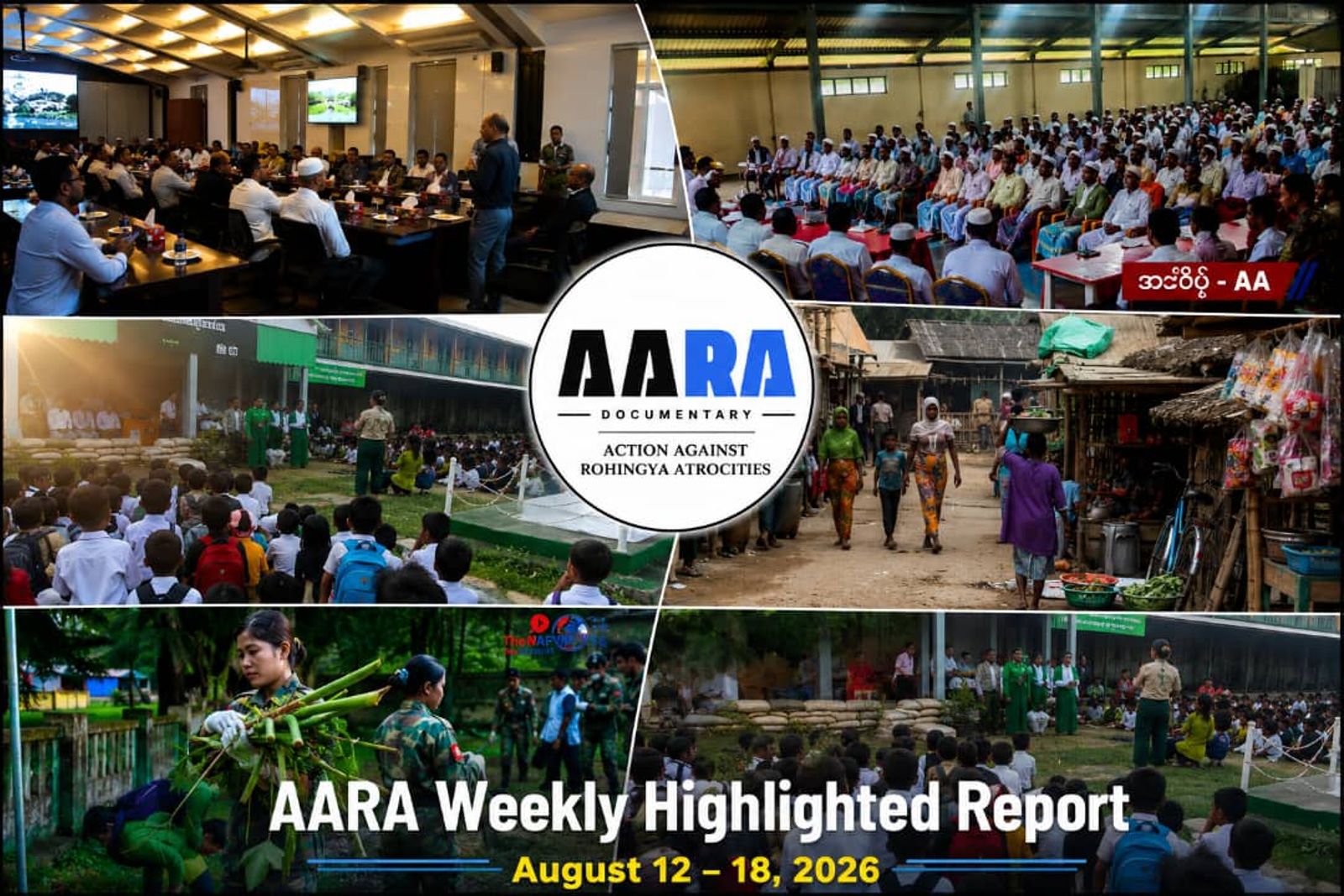
Reporting Period: August 12–18, 2026
Reports from August 12 to August 18, 2026, covering key developments across Rakhine State and the regional Rohingya crisis.
Parents Criticize School Fees and Tutoring Charges at Maungdaw High School No. 2
August 12, 2026
Parents of students at Basic Education High School No. 2 in Ward 2, Maungdaw, Rakhine State, report that the school is collecting monthly fees from students based on their grade level. Additionally, they allege that primary and middle school students are being pressured by their homeroom teachers to take private tuition.
According to parents, the monthly school fees are as follows: 10,000 Kyats for kindergarten and Grade 1; 15,000 Kyats for Grades 2 and 3; 20,000 Kyats for Grades 4 and 5; 25,000 Kyats for Grades 6 through 9; and 30,000 Kyats for Grades 10 through 12.
Furthermore, parents claim that attending tuition with their current school teachers costs an additional 50,000 Kyats per month for primary students and up to 80,000 Kyats per month for middle school students.
While some parents can afford these tuition fees, many families are struggling economically and cannot bear the extra cost, they added.
Parents also accuse some homeroom teachers of threatening students, stating that they would not pass exams or would face punishment if they did not attend the tuition classes.
A guardian, identified by the pseudonym Maung Maung, recounted that after his Grade 3 daughter failed an exam, he approached the homeroom teacher. The teacher allegedly told him that his daughter had repeatedly been advised to attend tuition but refused, resulting in her failure.
One parent expressed that due to such circumstances, her daughter in Grade 2 no longer wants to go to school. She stated the child is suffering psychologically from the teacher's scolding and pressure to attend tuition.
"Paying 50,000 Kyats a month for a Grade 2 child is not feasible for every family. On top of the current economic difficulties, having to pay school fees and tuition fees is a heavy burden on parents," one parent remarked.
Parents are urging that students' right to education and their exam success should not be tied to their ability to pay for tuition, and that teachers should refrain from pressuring or threatening students.
RRRC Hosts Briefing for BCS Officials and Capstone Fellows on Rohingya Issue
August 12, 2026
The Office of the Refugee Relief and Repatriation Commissioner (RRRC) in Bangladesh hosted a delegation today, August 12, comprising 45 Capstone Fellows from the Capstone Course 2026/2 and 89 Bangladesh Civil Service (BCS) officials from the 146th, 147th, and 148th Law and Administration training courses.
During the meeting, the Refugee Relief and Repatriation Commissioner, Mohammad Mizanur Rahman, provided a detailed briefing on the geopolitical context, historical developments, humanitarian response mechanisms, repatriation efforts, and the broader challenges faced in managing the Rohingya refugees in Bangladesh.
Participants engaged with high interest, asking numerous questions related to policy, governance, humanitarian coordination, and the regional implications of the Rohingya crisis.
The RRRC office stated that such educational and professional experience-sharing initiatives are crucial for enhancing institutional understanding within government departments and for building the knowledge of future civil service leaders on the Rohingya issue and refugee management. The RRRC reiterated its commitment to continuing to support knowledge-sharing processes and hosting meaningful discussions.
IIMM Documents Allegations of Crimes Against Rohingya in Rakhine State
August 12, 2026
The UN's Independent Investigative Mechanism for Myanmar (IIMM) has documented allegations of killings, sexual violence, forced displacement, and arbitrary detention of Rohingya, reportedly committed during periods of intense fighting between the Myanmar military and the Arakan Army (AA) in Rakhine State.
The IIMM's 2026 annual report, released on August 11, outlines progress in investigations from July 1, 2025, to June 30, 2026.
The report notes that violence in Rakhine State is not solely attributable to the Myanmar military but also includes allegations against other armed groups, including the AA.
Allegations against the AA include instances of sexual and gender-based violence against Rohingya women, rape, killings in Kyauktaw Township, and the forced recruitment and use of children under 15.
The report also includes allegations of the destruction of Rohingya mosques and the repurposing of mosque lands for settlements by non-Rohingya individuals.
These actions reportedly increased significantly from 2024 onwards, coinciding with the AA's offensives in the Buthidaung and Maungdaw areas.
The IIMM has also documented the secondary displacement of Rohingya into Bangladesh after the AA cleared areas in Rakhine State where they resided. Investigators have gathered evidence indicating that the targeting of Rohingya was accompanied by ethnically and religiously derogatory language.
Simultaneously, the IIMM has collected allegations of continued aerial and artillery attacks by the Myanmar military, which have reportedly impacted civilians and civilian infrastructure. The report highlights a significant increase in such attacks on civilians, schools, hospitals, markets, and religious buildings since 2025.
Allegations also include the forced displacement of Rakhine civilians in Sittwe Township, arbitrary detention, and the targeting of people in detention centers by military-affiliated armed groups. The IIMM has also gathered information on the denial or restriction of humanitarian aid, leading to deaths from starvation.
According to the IIMM's records, the conflict in Rakhine State persists not just as a military confrontation between the military and the AA, but as a humanitarian crisis impacting the lives, security, homes, and property of civilians.
The situation is particularly complex for the Rohingya. Following the mass exodus of hundreds of thousands to Bangladesh after the 2017 military operations, those remaining in Rakhine have again been displaced by subsequent fighting and violence.
The IIMM's documentation now includes allegations of sexual violence against Rohingya women, the destruction of homes and religious sites, land use changes, and forced displacement. Therefore, the prospect of return for Rohingya is now tied not only to security and access but also to recovering their homes, land, religious sites, and properties.
It is important to note that the information regarding the AA in the IIMM report is based on evidence and allegations gathered during the investigation and does not represent a final judicial determination.
The IIMM is a UN mechanism tasked with collecting, preserving, and analyzing evidence of the most serious international crimes committed in Myanmar, to be shared with relevant judicial bodies for future prosecution. The separate documentation of allegations against the AA and the Tatmadaw underscores that the primary goal of international investigations is to identify and ensure accountability for perpetrators of crimes, irrespective of their affiliation.
For the Rohingya, the core challenge remains creating conditions that guarantee their right to life, security, return, and property rights, regardless of the evolving political and military landscape.
Interfaith Harmony Activities Conducted in Maungdaw and Buthidaung
August 12, 2026
Residents from diverse ethnic and religious backgrounds, along with youth and local authorities, collaborated on clean-up activities at religious sites and community areas in Maungdaw and Buthidaung towns in Arakan State.
On August 11, a social harmony initiative in Maungdaw involved joint clean-ups at the Shwe Zigon Pagoda, Jama Mosque, and a Hindu temple. Similarly, on August 9, a similar clean-up was held at religious sites in Buthidaung.
The activities saw participation from local residents, government staff, ULA/AA forces, Muslim women's forces, women's groups, party youth groups, Hindu youths, ward administrators, and members of other social organizations.
These efforts were part of a "Social Harmony Campaign," aiming not only to beautify religious sites but also to foster mutual respect and understanding among different ethnic and religious groups, promoting peaceful coexistence within the community.
A Muslim women's force member told The Naf Waves, "Although we come from different ethnicities, religions, and backgrounds, if we respect and understand each other, we can live together peacefully. Social harmony cannot be built by one side alone; everyone must collaborate." She expressed gratitude for the ULA/AA government's efforts to facilitate coexistence and social harmony.
In the Arakan region, governed by the ULA/AA, the active participation of community members in administrative and social affairs is seen as strengthening local ownership and social responsibility.
In diverse communities like Maungdaw and Buthidaung, public involvement in maintaining religious sites and public spaces demonstrates the possibility of cooperation amidst differences.
One resident remarked, "I am delighted to see people from different ethnic and religious backgrounds working together. It's important that people don't just care for their own religious sites but also help clean others' places of worship together. This helps us understand each other better."
Residents view these activities not merely as cleaning exercises but as foundational steps towards building inter-community cooperation, mutual respect, and collective action for the common good.
Kyauktaw Plans Fees for Rakhine Teachers; Concern Over Rohingya Volunteer Teachers Becoming Jobless
August 12, 2026
Concerns are rising within the Rohingya education community in Kyauktaw Township, Rakhine State, over a plan to collect monthly fees from students to pay for registered Rakhine teachers appointed by the AA/ULA in Rohingya schools, according to a local Rohingya teacher.
According to a member of the Kyauktaw Rohingya Schools Committee, the township education official, U Ba Thaung, had stated that ULA-registered Rakhine teachers (6 to 7 of them) would be deployed to teach at Rohingya schools, while Rohingya volunteer teachers would still be needed.
The plan involves collecting monthly fees of 10,000 Kyats per primary student, 20,000 Kyats per middle school student, and 30,000 Kyats per high school student. A source, a schoolteacher, indicated that these funds are intended solely for the Rakhine teachers' salaries, not for the Rohingya volunteer teachers, as per a township-level ULA education staff member.
For instance, a family with two middle school children would pay 30,000 Kyats per month, and 40,000 Kyats for three. For two primary children, it would be 15,000 Kyats, and 20,000 Kyats for three.
Following the 2012 conflicts, the Rohingya community in Kyauktaw has been running its own schools using volunteer teachers. They provided free education for poor children, with teacher salaries managed collectively by village families.
Previously, fees collected for volunteer teachers were only between 5,000 and 10,000 Kyats per student per month. Now, the new plan introduces a separate monthly fee for the registered Rakhine teachers, while the villages will still need to manage the costs for the volunteer teachers separately.
Furthermore, it is reported that the registered Rakhine teachers would only come to the school for three days a week but would receive full pay.
The Kyauktaw Rohingya Schools Committee fears this arrangement will significantly increase monthly costs for families with multiple children, potentially making education unaffordable for poor families and forcing children out of school. One parent stated, "Having to pay this monthly fee is not easy for any family. Amid current economic hardships, paying this school fee is a burden for parents."
Without salaries, many Rohingya volunteer teachers could become jobless, raising the question of how children's education would continue.
Therefore, the Rohingya Schools Committee is calling on township education authorities to review this school plan and take measures to prevent Rohingya children from dropping out of education.
AA States it Has Seized All Rohingya Farmlands in Maungdaw District, Will Lease Back to Original Owners, at Meeting
August 13, 2026
At a meeting with the Rohingya community on August 8, 2026, AA/ULA leaders declared that all farmlands historically owned by Rohingya residents in Maungdaw District, northern Rakhine State, are now the property of the AA/ULA. They stated that Rohingya people would have no ownership rights over the land, only usage rights.
Around 11 a.m. on August 8, nearly 400 Rohingya villagers from across Maungdaw Township were reportedly summoned to Naga Kha (10) for the meeting with the AA/ULA.
Attendees from the ULA side included district and township-level officials, a political officer, and a jury team, who delivered the announcement, according to sources.
A meeting attendee told MDN that the ULA District Officer declared all farmlands formerly owned by Rohingya in the district are now the property of ULA. He stated that if "you Muslims" wish to cultivate these lands, you cannot do so freely but must obtain permission from the ULA.
After the District Officer's statement, a local Rohingya community leader asked for clarification: "Does this statement refer to the farmlands of the Rohingya currently residing in Maungdaw and Buthidaung, or does it refer to the lands of those who are war-displaced in another country?" The District Officer replied that it applies to both the lands of current residents and those of displaced Rohingya.
The community leader further recounted the District Officer's response: "Although you Muslims owned this land before, you no longer have ownership rights. You will only have cultivation rights. If you want to farm, you must pay the tax set by senior officials per acre."
Junta Reports 4,241 Criminals Included in Bangladesh's Displaced Persons List
August 16, 2026
Myanmar's military junta's Ministry of Foreign Affairs announced on August 15 that, upon verification, the list of displaced persons provided by Bangladesh for repatriation includes 4,241 individuals who have committed crimes.
The junta stated that of the 828,824 people on the list from Bangladesh, 426,545 have been verified as of July 31, 2026.
Of those verified, evidence shows that 308,797 individuals previously resided in Rakhine State, while for 113,507, no such evidence was found.
The junta also claimed that among the verified individuals, 4,241 are criminals, including members of the ARSA armed group. This number represents about 1% of the 426,545 already verified.
The current verified number is just over half of the total list provided by Bangladesh. The junta said it would continue verifying the remaining names.
The Ministry of Foreign Affairs stated that those verified as having actually lived in Rakhine State would be assisted with voluntary, safe, and dignified return to their places of origin in coordination with Bangladesh.
The junta has previously stated that it plans to coordinate with Bangladesh to accept returnees once the security situation in Rakhine State improves.
The announcement noted that agreements for the return of displaced persons had been reached previously between Myanmar and Bangladesh, and plans were made for returns in 2018 and 2019, but no one actually repatriated.
Myanmar and Bangladesh Disagree on Rohingya Refugee Numbers
August 18, 2026
Disagreements persist between Myanmar and Bangladesh regarding the number of Rohingya refugees verified by Myanmar and the process of repatriation.
In a statement on August 15, Myanmar's Ministry of Foreign Affairs claimed that only about 540,000 Rohingya fled to Bangladesh during the 2016-2017 period. It further stated that before the ARSA attacks, there were over 740,000 "Bengali" people in Rakhine State, and that over 200,000 remained afterward.
However, Bangladesh's Refugee Relief and Repatriation Commissioner (RRRC), Mohammad Mizanur Rahman, rejected Myanmar's population figures. He stated that there are currently over 1.2 million Rohingya in Bangladesh, explaining that population discrepancies could arise due to births in the camps since 2017.
Bangladesh also maintains that it has already provided the necessary information to verify individual refugees for repatriation to Myanmar.
Latest news

AARA Alleges 51 Rohingya Civilians Detained, Elderly Man Killed in Rathedaung Township by Militant Arakan Army (AA)
Rohingya villagers face urgent concerns over a reported deadline imposed by the militant Arakan Army (AA) to leave their homes by October 17, 2026, raising fears of further displacement and loss of shelter.
1,500 Myanmar Nationals Deported from Malaysia Aboard Junta Warships Amid Airstrike Horror
Malaysia has begun deporting around 1,500 Myanmar nationals despite ongoing conflict, forced conscription risks, and warnings that safe and dignified return remains impossible.
August 25 and the Hindu Massacre Narrative: How the Arakan Army Is Shifting Blame Toward Rohingya and ARSA
The article examines how the Arakan Army's August 25, 2026 Hindu commemoration presents the 2017 Hindu massacre as an ARSA crime, raising questions over efforts to shift blame onto Rohingya and reshape the history of the Rohingya genocide.