Rohingya Crisis Deepens as AA Restrictions, Land Confiscations and Abuses Escalate in Rakhine State
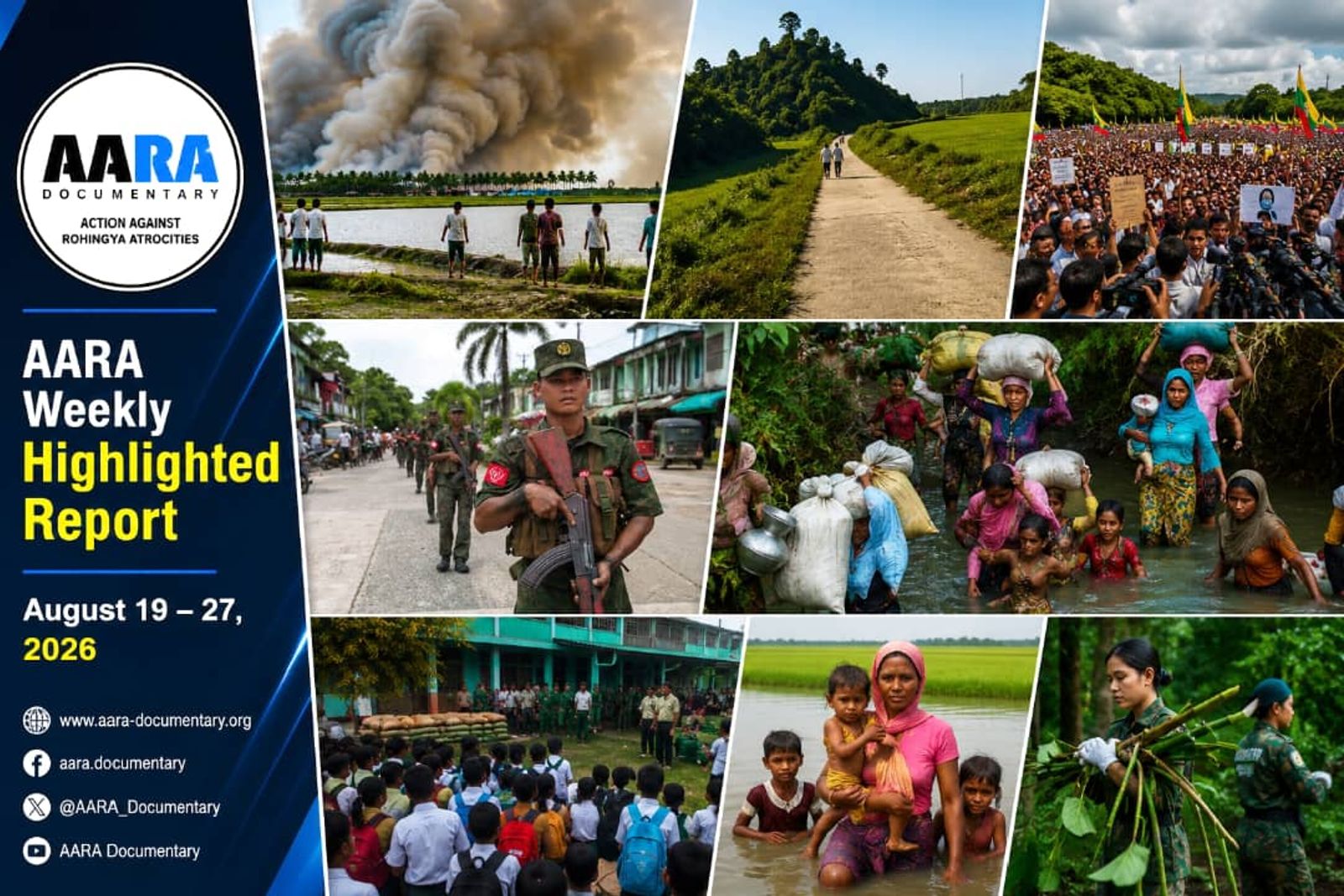
The week saw intensified restrictions, land and property confiscations, forced recruitment, and other alleged abuses by the Arakan Army (AA) against Rohingya in Rakhine State, alongside documentation of a 2024 Buthidaung massacre and growing international calls for accountability.
I. EXECUTIVE SUMMARY
This reporting period coincides with the ninth anniversary of the August 2017 Myanmar military crackdown that forced over 740,000 Rohingya to flee to Bangladesh. The week has been marked by intensified restrictions imposed by the Arakan Army (AA) on Rohingya in northern Rakhine State, new documentation of abuses in a UN report, and growing international calls for accountability. Key developments include the AA's order requiring Rohingya to register overnight stays, ongoing land and property confiscations, increasing restrictions on movement and internet access, and the reported massacre of at least 170 Rohingya in Buthidaung in May 2024—an incident that underscores the grave and ongoing threat to the community.
II. DETAILED INCIDENT REPORTING
A. New Restrictions Imposed by the Arakan Army (AA)
1. Mandatory Guest Registration Order (August 25)
The AA/ULA announced via loudspeaker on the evening of August 25 that Rohingya residents in northern Maungdaw Township must now report to authorities if they wish to stay overnight at another house within the same village or in a different village—whether as a guest or due to an emergency. Failure to comply will result in "severe action," according to local sources. The AA has also increased security patrols in the area, with squads of approximately 18 troops actively sweeping through Rohingya villages both day and night.
2. Guest Visit Reporting Requirement (Ongoing)
Local sources report that Rohingya are now required to report in advance to village-level AA authorities if they intend to visit another village or receive guests from outside their village. Guest lists must be submitted to local AA administrative bodies.
3. Restrictions on Starlink Internet Access (Ongoing)
In Buthidaung Township, Starlink internet access is available only to ethnic Rakhine. Rohingya wishing to use Starlink must pay ethnic Rakhine users 3,000 kyat per hour. Rohingya affairs offices, including the Juri Office and Muslim Affairs offices, reportedly have no direct Starlink access.
B. Land and Property Confiscations
1. Land Transaction and Construction Ban (August 21)
AA/ULA authorities have prohibited Rohingya in Maungdaw Township from buying or selling residential or agricultural land, erecting fencing, or expanding residential buildings. Violators face "legal action," according to sources.
2. Systematic Land and Property Registration
The AA continues to collect detailed records of Rohingya-owned agricultural land, residential land, and shrimp farms in Maungdaw and Buthidaung townships. Properties belonging to Rohingya who have fled to Bangladesh or other countries are being classified as ownerless and confiscated as AA/ULA treasury assets. Even family members of original owners are reportedly denied claim rights.
3. Forced Removal of Fencing
In April 2026, the AA threatened at least 16 villages with severe consequences if fences were not removed by April 10, according to AARA documentation.
C. Human Rights Violations and Abuses
1. UN Report Documents Systematic Abuses
On August 24, the UN Office of the High Commissioner for Human Rights released a report covering June 2025 to May 2026, documenting:
· AA abuses: Arbitrary arrests, torture, sexual and gender-based violence, forced labor and recruitment, destruction of villages and religious sites.
· Torture methods: Beatings with bamboo, burning with matches, hanging upside down with bodies spun until loss of consciousness, application of chili to genitals, and fingernail removal.
· Child exploitation: Children as young as six forced to clear forests, build structures, and perform manual labor.
· Forced recruitment: Rohingya attempting to escape conscription face detention and routine ill-treatment.
2. Buthidaung Massacre Documentation
Human Rights Watch published a report in May 2026 documenting evidence that at least 170 Rohingya, men, women, and children, were killed in a massacre in Buthidaung Township in May 2024, allegedly carried out by the AA. The AA has denied the allegations.
3. Maritime Disasters
In late June 2026, over 500 Rohingya asylum seekers were feared to have drowned after two overcrowded boats disappeared off Myanmar's coast. A separate incident in the Andaman Sea left at least 250 people missing.
III. NINTH ANNIVERSARY OBSERVANCES AND RESPONSES
A. International Community Statements
· United Nations: UN High Commissioner for Human Rights Volker Türk described the situation as "suffering, misery, and cruelty on multiple levels and across the country that is heartbreaking". UN Secretary-General António Guterres noted that Rohingya face "deepening insecurity, shrinking protection space and diminishing prospects for durable solutions".
· United Kingdom: British Embassy Chargé d'Affaires Andrew Jackson reaffirmed commitment to pursuing justice and accountability, emphasizing that sustainable peace cannot be achieved without Rohingya inclusion in Myanmar's political future.
· Canada: The Canadian Embassy marked the anniversary by noting that the crisis remains one of the largest and most protracted refugee emergencies globally, with over 1.3 million displaced.
· Special Advisory Council for Myanmar (SAC-M): Called justice for Rohingya genocide perpetrators "a moral imperative" and demanded an independent international investigation into alleged AA massacres.
B. ICJ Proceedings
Rohingya survivors testified before the International Court of Justice in January 2026 as part of The Gambia's genocide case against Myanmar. The ICJ is expected to deliver its judgment later this year.
IV. REGIONAL CONTEXT AND CONFLICT DYNAMICS
A. Military Situation in Arakan (Rakhine) State
• The Myanmar junta has deployed approximately 2,000 troop reinforcements from Light Infantry Division 55 to Magway Region, preparing a renewed ground offensive toward AA-controlled Taungup Township.
• The regime continues to rely heavily on indiscriminate airstrikes targeting civilian population centers across Rakhine State.
• The AA has captured 14 of Rakhine State's 17 townships since launching its 2024 offensive and is now pushing toward Sittwe and Kyaukphyu.
B. Displacement Crisis
• Over 150,000 Rohingya have fled Myanmar since 2024, most crossing into Bangladesh.
• Total Rohingya refugee population in Bangladesh now exceeds 1.2 million.
• Conditions in Cox's Bazar camps continue to deteriorate due to international aid cuts, restrictions on employment and education, and criminal networks operating within the camps.
V. DOCUMENTED ABUSE CATEGORIES
| Category | Description |
| Restrictions | Mandatory guest registration, overnight stay reporting, land transaction bans, fencing removal orders, Starlink access denial |
| Forced Labor | 50 men per village required without pay or food provision (April 2026) |
| Violence | Landmine injuries, extrajudicial killings, torture documented in UN report |
| Massacres | At least 170 killed in Buthidaung (May 2024) |
| Maritime Deaths | 500+ feared dead (June 2026); 250+ missing (April 2026) |
| Forced Conscription | Mandatory military recruitment of Rohingya across Arakan (Rakhine). |
VI. RECOMMENDATIONS
1. Independent International Investigation: Immediate investigation into AA atrocities and alleged massacres in Buthidaung.
2. Sanctions and Accountability: Targeted sanctions against AA leadership; support for ICC and ICJ proceedings.
3. Humanitarian Access: Urgent pressure on AA to allow unrestricted humanitarian access to all Rohingya areas.
4. Maritime Protection: Enhanced search-and-rescue operations in the Bay of Bengal and Andaman Sea.
5. Refugee Support: Increased funding for Rohingya refugees in Bangladesh and expanded livelihood/education opportunities.
Latest news

AARA Alleges 51 Rohingya Civilians Detained, Elderly Man Killed in Rathedaung Township by Militant Arakan Army (AA)
Rohingya villagers face urgent concerns over a reported deadline imposed by the militant Arakan Army (AA) to leave their homes by October 17, 2026, raising fears of further displacement and loss of shelter.

1,500 Myanmar Nationals Deported from Malaysia Aboard Junta Warships Amid Airstrike Horror
Malaysia has begun deporting around 1,500 Myanmar nationals despite ongoing conflict, forced conscription risks, and warnings that safe and dignified return remains impossible.
August 25 and the Hindu Massacre Narrative: How the Arakan Army Is Shifting Blame Toward Rohingya and ARSA
The article examines how the Arakan Army's August 25, 2026 Hindu commemoration presents the 2017 Hindu massacre as an ARSA crime, raising questions over efforts to shift blame onto Rohingya and reshape the history of the Rohingya genocide.