Rohingya Situation Report: Escalating Conflict, Atrocities and Forced Displacement in Rakhine
AARA’s September 8–16 report documents escalating fighting, continued displacement, ULA/AA abuses against Rohingya, Myanmar military attacks, and growing international efforts for accountability.
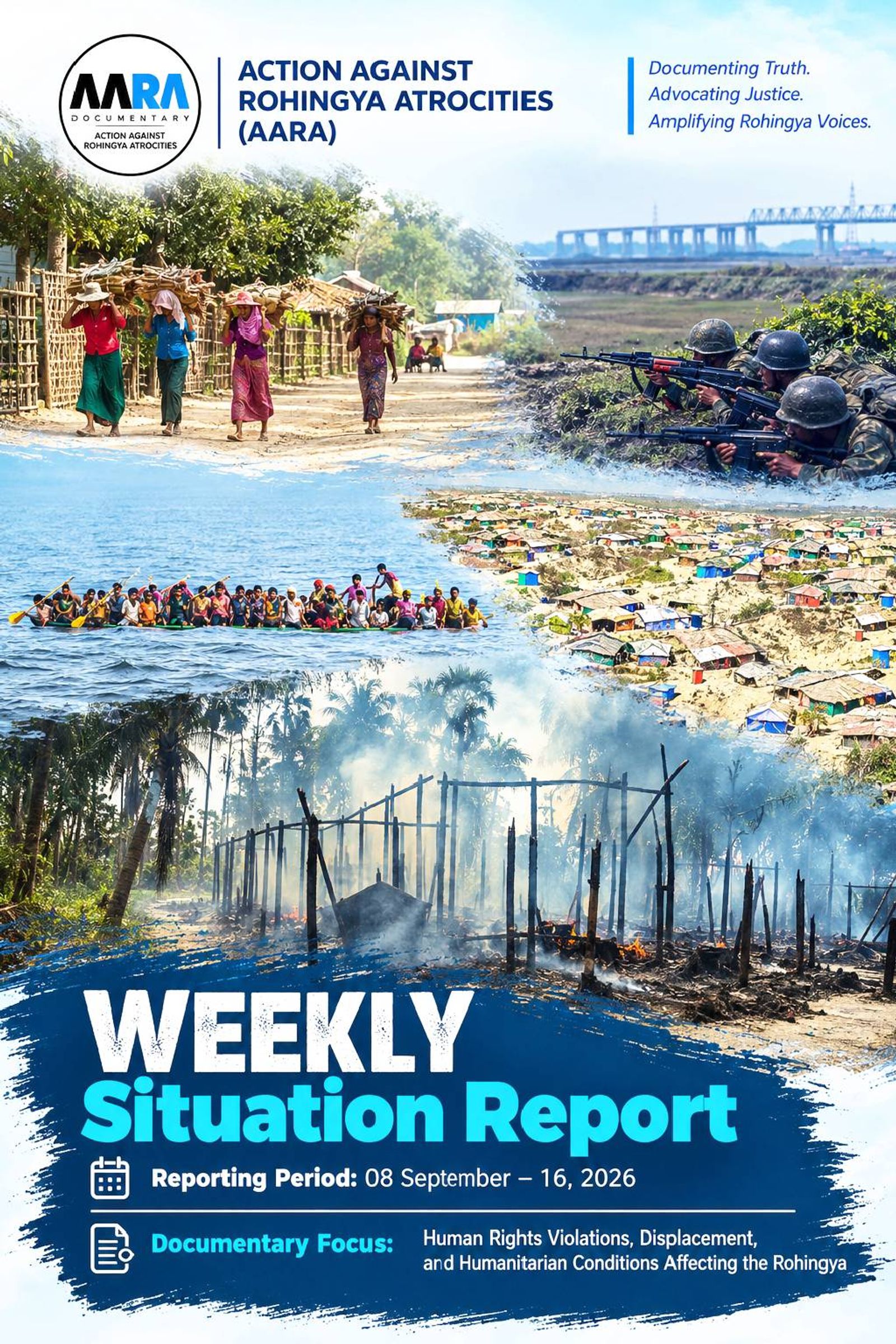
Reporting Period: September 8–16, 2026
EXECUTIVE SUMMARY
This week witnessed escalating military operations in Rakhine State with intensified fighting in Ponnagyun Township, continued displacement of Rohingya communities, and significant developments in international justice mechanisms. Key highlights include: (1) ongoing intense clashes between the Myanmar military and Arakan Army (AA) with heavy casualties on both sides; (2) submission of 25 Argentine arrest warrants against Min Aung Hlaing and military officers at the UN Human Rights Council; (3) UN High Commissioner for Human Rights urging ICC referral for Myanmar; (4) Bangladesh announcing plans to discuss Rohingya resolution with China and Myanmar; (5) documentation of ULA/AA atrocities against Rohingya including village destruction, forced displacement, and systematic discrimination; and (6) continued detention of Rohingya civilians by AA forces.
SECTION 1: MILITARY CONFLICT AND SECURITY SITUATION
1.1 Intensified Fighting in Ponnagyun Township
Date: September 8–16, 2026
Fighting between the Myanmar military junta and the Arakan Army (AA) in Ponnagyun Township, Rakhine State, has continued to intensify throughout the reporting period, with heavy casualties reported on both sides.
Key Developments:
The military junta launched counter-offensive operations using combined ground, air, and naval fire support.
AA troops reportedly forced to withdraw from some positions but have replenished forces and launched counter-attacks.
Military penetrated as far as AA defensive positions near Kwantawng Village.
Heavy artillery bases and naval warships in Sittwe providing fire support.
AA firing back with heavy weapons.
Casualty Reports:
According to ground-level military sources: "The military is using massive force and launching a fierce offensive... Although the AA side has had to temporarily withdraw from some positions, they have replenished their forces and launched counter-attacks, so both sides are suffering heavy casualties. The fighting could continue to intensify and casualties on both sides could continue to rise. However, the attacking military side is suffering more casualties."
Airstrikes:
On September 7, military carried out airstrike on Phat Kya Village, destroying four houses (per AA statement)
On September 16, two fighter jets conducted airstrikes on Ponnagyun town and surrounding areas from just after 12:00 noon
Heavy artillery fire from Sittwe side continues
Battle Duration:
The battle at Sittwe-Ponnagyun junction entered its 13th day on September 16, having begun on September 4, 2026.
Ground Operations:
Ground offensives continuing in areas around Yay Yoe Pyin, Sar Taung Poh, War Bo, A Myint Kyun, and Chilaing Phin in Ponnagyun Township.
Drone Warfare:
Military council using drone operations more than before in the Sittwe-Ponnagyun offensive. Pro-military lobbyist Nay Ri Moe stated the operation's aim could be to apply pressure for peace negotiations or attempt to regain a foothold in southern Rakhine.
1.2 Spillover Effects and Geographic Expansion
Date: September 8, 2026
Military observers and ground-level sources warned that as military airstrikes continue to intensify, the combat area could expand and civilian casualties could increase further.
Potential Expansion Areas:
Beyond Sittwe, Ponnagyun, Rathedaung, and Pauktaw, spillover effects could increasingly be felt in:
- Maungdaw
- Buthidaung
- Kyauktaw
- Mrauk-U
- Minbya
Ongoing Airstrikes:
Military continues to carry out airstrikes on areas around Ponnagyun, Kyauktaw, and Mrauk-U.
1.3 Unexploded Ordnance Incident
Date: September 11, 2026 | Reported: September 13, 2026
At approximately 10:00 PM on September 11, an artillery shell landed in a paddy field near Santawli Village (a Rohingya village) in Sittwe Township. The shell remained unexploded due to soft ground.
Current Status:
Military personnel came to inspect but have not taken action to prevent explosion
Villagers remain worried about potential detonation
SECTION 2: INTERNATIONAL JUSTICE AND ACCOUNTABILITY
2.1 Argentine Arrest Warrants Submitted at UN Human Rights Council
Date: September 7–8, 2026
At the 63rd regular session of the UN Human Rights Council in Geneva, Switzerland, U Tun Khin, President of the Burmese Rohingya Organization UK (BROUK), submitted a request urging the international community to practically implement and arrest 25 arrest warrants issued by an Argentine court.
Details:
- Warrants target junta leader Min Aung Hlaing and Myanmar military officers
- Issued through a case filed by BROUK in Argentina under the principle of universal jurisdiction
- Submitted during Enhanced Interactive Dialogue discussing Myanmar's human rights situation
BROUK Statement:
"Court decisions must be respected and implemented. If arrest warrants are issued, it must lead to actual arrests."
Warning:
U Tun Khin warned that while international justice processes may take a long time, the Rohingya no longer have time to wait further: "If justice comes after many years and there are no Rohingya left, it becomes meaningless. We cannot allow the Rohingya to disappear from Myanmar and then be promised justice later. The international community must take practical action now to stop the genocide, end impunity, and ensure that the Rohingya have a future in their homeland."
2.2 UN Human Rights Chief Urges ICC Referral
Date: September 8, 2026
UN High Commissioner for Human Rights Volker Türk urged member states to refer Myanmar's worsening human rights situation to the International Criminal Court (ICC).
Key Statements:
- Called for immediate halt to shipment of weapons, ammunition, aviation fuel, and key supplies to Myanmar military
- Confirmed at least 1,200 civilians killed during reporting period; other sources indicate death toll could exceed 3,000
- Main cause of civilian deaths: airstrikes
- Rohingya in Rakhine State facing arbitrary arrests, torture, sexual violence, and forced recruitment
Warning Against Normalization:
- Türk warned about efforts to normalize relations with Myanmar's military junta without evidence of compliance with international law. Any engagement must be based on:
- Stopping violence
- Allowing delivery of humanitarian assistance
- Releasing arbitrarily detained persons
- Repatriation Warning:
- Forced repatriation of Rohingya would amount to a blatant violation of international law due to unstable conditions.
2.3 IIMM Evidence Collection
Date: September 8, 2026
Nicholas Koumjian, head of the Independent Investigative Mechanism for Myanmar (IIMM), stated that grave international crimes are being committed in Myanmar.
Evidence Collected:
Investigators identified those involved in airstrikes
Documented military operations that repeatedly attacked rescue workers
Evidence from more than 1,600 sources and more than 1,750 witnesses
Key evidence provided to International Court of Justice (ICJ) regarding genocide in Myanmar
2.4 ICJ Genocide Case Analysis
Date: September 14, 2026
Dr. Azeem Ibrahim, Director of Special Initiatives at New Lines Institute for Strategy and Policy, published analysis in Arab News titled "If Myanmar is found responsible for genocide, what next?"
Key Points:
- If ICJ rules Myanmar guilty of violating Genocide Convention, responsibility will fall on current military AND successive future governments
- The Gambia filed case against Myanmar at ICJ in 2019 under Genocide Convention
- ICJ rejected Myanmar's preliminary objections in 2022
- Main hearings held in January 2026; Gambian Justice Minister indicated ruling could come in October
- State Responsibility vs. Individual Guilt:
- State responsibility continues even if military relinquishes power
- Future democratic government would inherit previous state's responsibilities
- Future democratic leaders would NOT be held personally guilty for 2017 crimes
- State responsibility and individual guilt are separate matters
Required Actions:
Responsibilities include:
- Restoring equal citizenship rights to Rohingya
- Protecting and resolving property claims
- Ensuring political representation
- Creating credible security guarantees
- Creating conditions for voluntary return in safety and dignity
Warning:
"If the ICJ's ruling merely determines that genocide occurred but does not change the current situation of the Rohingya, complete justice would not be possible."
SECTION 3: ULA/AA ATROCITIES AGAINST ROHINGYA
3.1 Detention of Rohingya Civilians
3.1.1 Village Administrator and Sons Detained
Date: September 5, 2026 | Reported: September 9, 2026
AA troops arrested U Abu, administrator of U Kyin Kya Village in northern Maungdaw Township, along with his two sons.
Circumstances:
AA troops came to U Abu's home on September 5
Family members have been unable to make contact since arrest
Local sources report U Abu was respected in community and helped the poor
He had opposed activities of the ASA group
Allegations:
According to sources, narcotics and a pistol were allegedly planted at U Abu's home, and it was claimed he was arrested based on a report to the AA.
3.1.2 Rohingya Man Detained After Medical Treatment in Bangladesh
Date: September 13, 2026
Swe Yod Nur, son of Moh Nur Ahmawd, aged 47, from Bo-gyi-chaung Village in Buthidaung Township, was detained by AA one day after returning from medical treatment in Bangladesh.
Details:
Arrested at approximately 10:45 AM on September 13
Had traveled to Bangladesh for stomach condition surgery
News of arrest heightened fears within Rohingya community
Community Response:
A Rohingya community elder stated: "When people cannot get proper medical treatment in their own area, they have no choice but to go to Bangladesh for treatment. Patients should not face the risk of arrest just because they return home."
Another Rohingya from Buthidaung added: "Ordinary Rohingya people are suffering because of restrictions and lack of security. What we need is healthcare and basic rights, not more fear and arrests. There is a need to provide greater protection for civilians who travel to access essential services."
3.1 Khami Man Arrested for Documenting Forced Conscription
Date: September 3–4, 2026 | Reported: September 14, 2026
Ko Aung Kyaw Sein from Ywar Thit Village in Buthidaung Township was arrested after posting a video showing AA forcibly conscripting people.
Timeline:
September 3: Posted Facebook video showing AA forcibly detaining Khami youths from Ywar Thit Village
September 4: AA members came to his home and arrested him
No contact since arrest; family unaware of his location
Witness Statement:
"He was arrested over the matter of recording with a phone and posting online AA's forced conscription in their village."
Context:
On September 3, more than 100 Khami youths from approximately 10 villages were detained by ULA/AA for military service.
3.2 Forced Displacement and Village Destruction
3.2.1 Comprehensive Documentation of ULA/AA Atrocities in Buthidaung
Date: September 14, 2026
A comprehensive report documented systematic atrocities committed by ULA/AA against Rohingya people in Buthidaung Township.
Human Shields and Initial Attacks:
Although ULA/AA gave advance warnings and evacuated Rakhine, Hindu, and other ethnic groups before urban battles, they ignored the Rohingya. When fighting began, they entered Rohingya villages, using Rohingya people as human shields while attacking the Myanmar military.
Looting and Destruction:
After driving out Rohingya people, ULA/AA looted and carried away:
- Rice and paddy
- Household items
- Cargo trucks and delivery vehicles
- Motorcycles and tipper trucks
- Glass-paneled vehicles
- Clothing
- Taungoktaw wooden furniture
- Buffaloes, cows, chickens, goats
- Mobile phones
- Household solar panels and batteries
- Rice mills and tractors
- Motorized boats and engines
- Entire villages were then burned down.
- Village Tracts Burned Down in Buthidaung Township (29 total):
- Kantaing Village Tract
- Ywethnitaung Village Tract (North Village, South Village)
- Tharakkaing Manu Village Tract
- Dapyuchaung Village Tract
- Htan-yauk-khan Village Tract
- Pyar Bo Min Village Tract
- Kyet-hmauk-taung Village Tract
- Sein-nyin-way Village Tract
- Nan-yar-kone Village Tract
- Kantaing Nan-yar-kone Village Tract
- Ywarma Rohingya Village Tract
- Ei Maw Dein Para Village Tract
- Say Raung Far Ra Village Tract
- Ba-kone Nar Taung Htip Village Tract
- Let-we-da-pyin-shay Village Tract
- Tat-ma-chaung Village Tract
- Pu-sun-chaung Village Tract
- Kyauk-pha-yon-taung Village Tract
- Nga-kyin-taung Village Tract
- Ku-mi-ka-li Village Tract
- Mi-kyaung-gaung-swe Village Tract
- Ba-da-nar Village Tract
- Raung-far-ra Village Tract
- Hauk-mu-ra Village Tract
- Zedi-pyin Rohingya Village Tract
- Ah-thet Baw-gaw-li Village Tract
- Phan-si Village Tract
- Ka-kyet-bet-kan-pyin Village (Tat-yar Village)
- Oh-the Village
Destruction of Religious and Educational Institutions:
- 111 Islamic mosques demolished and carried away
- 15 Arabic schools demolished
- 50 pre-primary Arabic schools demolished
- Casualties and Detentions:
- More than 1,000 people killed in mass shootings
- Hundreds of Rohingya men and women arrested and detained
- Property Confiscation:
- 29 Rohingya villages unlawfully seized
- Over 30,000 acres of farmland fully confiscated by armed force
- Rakhine encroachment settlements built on Rohingya village tracts and farmland
Extortion:
ULA/AA collected tax of 1 million kyats per person from thousands of Rohingya and arranged transport to Thailand, Malaysia, and Bangladesh.
Current Situation:
Hundreds of Rohingya remain as displaced persons in other village tracts and urban wards. The report states: "The above points are precise facts, and according to information gathered by people currently living on the ground in Arakan, the actual numbers could be even higher --- but certainly not lower."
3.2.2 Comparison to 2017 Genocide
Date: September 14, 2026
The report states that ULA/AA carried out a clearance operation that has reached a situation worse than the Myanmar military's genocide in 2017.
Evidence of Discrimination:
- Permission to install Starlink for internet use not granted to Rohingya, only to Rakhine people
- Travel to Maungdaw District requires two guarantors, 5,000 kyats fee, and one-day recommendation letter from township administrative office
- Internet can only be used during hours designated by ULA/AA
Worsening Conditions:
"Conditions under the ULA/AA armed group are worse than during the military era."
3.2.3 Economic Hardship and Starvation
Date: September 14, 2026
Rohingya remaining in Maungdaw and Buthidaung towns face starvation as rice prices and consumer goods prices have risen.
Employment Discrimination:
NGO and INGO organizations entering Rakhine State through covert means hire only Rakhine people as staff
Educated Rohingya who apply reportedly do not make it to the short list
Education Costs:
- Monthly teacher salaries: 10,000 to 50,000 kyats required from Rohingya students
- Monthly contributions to national fund: 3,000 to 5,000 kyats
- Garbage fees: 5,000 kyats per household, up to 3,000 kyats per shop
- Restrictions:
- Not permitted to go to forests and mountains to collect firewood (areas confiscated by ULA/AA)
- In schools, students taught separately according to ethnicity and religion
- At Aleka (1) and Ah-htaka (2), Rakhine students taught separately
Discriminatory Language:
Although ULA/AA say "Muslim" outwardly, in their hearts they regard Rohingya as "Bengali Kala," using the term "Kala" when speaking among themselves.
The report concludes with the question: "Is there no longer justice for the Rohingya in the world?"
3.3 Rakhine Encroachment and Resettlement
3.3.1 Encroachment Villages in Southern Maungdaw
Date: September 15, 2026
ULA has continued building Rakhine encroachment villages and homes on former Rohingya villages in southern Maungdaw Township since last month.
Details:
- Rakhine families brought in from Rathedaung Township and southern Rakhine
- Construction on former sites of Gohduthara, Tharay Kone Baung, and Baguna villages (burned down during 2017 genocide)
- Land cleared with bulldozers
- 20-foot by 40-foot plots allocated per family
- Rakhine families displaced by fighting from southern Rakhine and Rathedaung Township being resettled
Previous Seizures:
Around end of 2025, AA/ULA seized former Rohingya villages in northern Maungdaw Township, including Pha-wat-chaung and Nwa-yon-taung villages, and built Rakhine encroachment villages.
Strategic Analysis:
According to a Maungdaw local, this is part of a plan under the Rakhine national ideology (Rakhhita Lann Zin) to balance the population. AA/ULA is now fully implementing plans that the previous military regime could only partially carry out.
Land Distribution:
Each family given 2 acres of farmland
One tractor provided per expanded/resettled Rakhine village
Tools and equipment for agricultural work provided
3.3.2 Forced Removal and Resettlement in Buthidaung
Date: September 15, 2026
AA has forcibly removed Rohingya from Buthidaung Township, including those holding land ownership, home ownership, and farmland ownership.
Resettlement Details:
- Rohingya resettled on eastern bank of Mayu River
- 20-foot by 40-foot plots allocated per family
- No assistance provided to Rohingya during rainy season
- Not permitted to enter nearby forests and mountains to cut bamboo or trees
- Economic Exploitation:
- Large depots nearby where Rakhine people sell bamboo, dhani palm, and timber posts
- Those with money can buy and build homes
- Approximately 99% facing starvation, pawning and selling belongings, fleeing to Bangladesh
Testimony from Displaced Rohingya Farmer:
"These are vacant plots and fallow land within the farmlands that Rohingya once owned and that were later seized by the military. AA is resettling people there. They give a plot of land. They give shelter. We have to build homes ourselves. The new site is extremely dangerous. Because the homes are too close to one another, there is great concern about fire hazards. Since wastewater and sewage disposal are unsystematic, communicable diseases could break out from there. We have reported this to AA, but there has been no response at all. We moved because they said we would be arrested if we did not relocate from our original village. We also cannot get back the farmland we once owned."
3.3.3 Scale of Displacement
Date: September 15, 2026
- Approximately 100,000 Rohingya displaced and fleeing since ULA/AA seized Buthidaung Township
- Tens of thousands forcibly removed and resettled in "refugee camps"
3.3.4 "Rakhhita Lann Zin" Implementation
Date: September 15, 2026
Within territories attacked and seized by AA, ULA/AA is leading and implementing "Rakhhita Lann Zin" (Rakhine national ideology).
Objective:
To make Rakhine people the majority population within townships or village tracts by:
Demolishing Rohingya villages
Forcibly displacing Rohingya
Expelling Rohingya from townships and village tracts with large Rohingya populations
Resettling Rakhine people in vacated Rohingya villages, farmlands, and homes
Specific Resettlement Locations:
- Maung-gyi-taung, Tat-min-chaung, and Kyaing-chaung/Tha-mi-kha-li in Buthidaung Township
- Hundreds of Rakhine families resettled since early May
- Rakhine families displaced by fighting from Rathedaung and Thandwe being resettled
- Rakhine villagers from Aung-lan-pyin expanded and took farmland near Aung-lan-pyin Rohingya village
- Rakhine villagers occupied Laung-chaung Village (known locally by Rohingya as Ru-sa-nar-bil)
Local Statement:
"Previously, Buthidaung and Maungdaw were places where Rohingya Muslims were the majority. Now, under AA's rule, the population ratio is being changed. The first priority is resettling Rakhine war-displaced people from Thandwe District and Rathedaung Township in Buthidaung, and the second priority is forcibly pressuring and clearing Rohingya villages in Maungdaw Township and preparing to resettle Rakhine people there under AA/ULA."
3.3.5 Villages Cleared in Buthidaung (Partial List)
Date: September 15, 2026
During 2025, ULA/AA forcibly pressured and cleared nearly 40 Rohingya villages, including:
- Pyin-shay Village Tract
- Maung-gyi-taung
- Kyet-mauk-taung Village Tract
- Da-byu-chaung Village
- Pu-lel-taung
- Aung-lan-pyin Village Tract
- Tharay Kone Tan
- Maung-hla-ma
- Kone Tan
- Nga/kyin-tauk
- Mi-kyaung-gaung-swe
- Laung-chaung
- Ah-twin-nget-thay Village
- Pyar-pin-yin
- Htan-yauk-khan
- Yweth-ni-taung Village Tract
- Kantaing Village Tract
- Thar-yet-kaing Ma-nu
- Mi-kyaung-ze Village
- Phay-tar-ah-li Village
- Myit-nar Village in Dar-paing-sar-yar Village Tract
- Nga-yant-chaung Village
- Kyi-note-thi Village Tract
- Dozens of other Rohingya village tracts
Rakhine people have already been resettled in Maung-gyi-taung and Tat-min-chaung villages, where Rohingya once lived.
SECTION 4: DIPLOMATIC AND POLITICAL DEVELOPMENTS
4.1 Bangladesh to Discuss Rohingya Issue with China and Myanmar
Date: September 10, 2026
Bangladesh's government announced it will hold discussions with China and Myanmar to seek a peaceful and sustainable solution to the Rohingya issue.
Announcement:
Deputy Foreign Minister Humayun Kabir made the announcement at an international conference titled "Protracted Rohingya Crisis: The Search for a Comprehensive Approach" held at the Foreign Service Academy in Dhaka.
Key Statements:
- Only a political solution can end the long-term displacement situation
- Bangladesh has hosted and protected more than 1 million Rohingya since 2017 mass exodus
- Situation has put pressure on economy, environment, public services, local communities, and national security
- Bangladesh will continue to support safe, voluntary, dignified, and sustainable repatriation
Call for International Responsibility:
"The Rohingya issue is not a crisis created by Bangladesh, nor is it a problem that can be solved by one country alone, and therefore greater active political engagement and shared responsibility from the international community are needed."
Diplomatic Approach:
- Bangladesh remains cautiously optimistic crisis can be resolved through diplomatic means
- Bilateral and multilateral discussions will be further expanded
- Will leverage role at UN General Assembly to keep Rohingya issue a continued priority
- Supports judicial processes regarding accountability for atrocities
- Efforts toward justice and sustainable repatriation must be advanced simultaneously
Conference Organizers:
- Department of International Relations at Dhaka University
- Foreign Service Academy
- UNHCR
Note:
No details released regarding timeline or specific format of discussions with China and Myanmar.
SECTION 5: COMMUNITY AND CIVIL SOCIETY RESPONSES
5.1 Criticism Over ULA Football Tournament Amid Airstrikes
Date: September 12–13, 2026
Local residents of Maungdaw criticized the "Maungdaw District Colonel Cup" football tournament organized by the Arakan National United League (ULA).
Event Details:
- Began September 12
- 34 teams from Maungdaw Township and Buthidaung Township competing
- Teams from various ethnic groups including Rohingya and Rakhine teams
- Held at Myoma sports ground in Maungdaw town
- 800,000 kyats collected from each administrator of wards and villages
Public Criticism:
As Myanmar military airstrikes continue in Rakhine State and people worry about danger from airstrikes, criticism emerged over holding a football tournament with large crowds.
Anonymous Statement:
"This is not just a football match. I see it as a match intended to change people's attitudes and divert attention."
5.2 Malaysian Preacher Urges Humane Treatment of Rohingya
Date: September 13, 2026
Malaysian Islamic preacher Firdaus Wong urged Malaysians not to treat Rohingya refugees inhumanely.
Key Statements:
"No one has the right to treat them inhumanely on the grounds that they have no citizenship, that they are Rohingya, or that they are refugees."
Context:
Speaking at New Muslim Community Conference 2026 held at Grand Hyatt Hotel in Kuala Lumpur.
Comparison to Palestinian Experience:
"Just as we do not like what happened in Palestine, that situation also began from a position of viewing Palestinians as less than human. It is the same for the Rohingya."
On Basic Rights:
"Even prisoners of war have their rights. They must be given food, and they must not be tortured."
Earlier Statement (September 4):
Glorene Das, Executive Director of Tenaganita, stated that public anger toward Rohingya stems from ignoring root causes of real social problems.
Das's Points:
- Rohingya face difficulties because they lack legal permission to work or legally study
- They also lack secure legal status
- Those who break the law should be held accountable
- Society as a whole should not be blamed or treated inhumanely based on actions of a small number of people
SECTION 6: BORDER INCIDENTS AND REGIONAL SECURITY
6.1 Bangladeshi Fisherman Injured by AA Gunfire
Date: September 14, 2026 | Reported: September 15, 2026
Muhammad Idris, a 55-year-old fisherman, was injured by gunfire from the Arakan Army (AA) while fishing in Myanmar territorial waters in the Naf River.
Incident Details:
- Time: Approximately 4:20 PM on September 14
- Location: Eastern Naf River near Nazi Village
- Injury: Gunshot wound to right knee
Witness Account:
According to local fishermen, AA members chased fishermen away, telling them not to fish. While fishermen were trying to leave the area, they were shot at, and one bullet struck Idris.
Confirmation:
Zahid, chairman of Sallus Gate Fishermen's Association No. (1) in Jaliapara, Teknaf Township, confirmed the incident.
Official Response:
S M Anous Chowdhury, Upazila Nirbahi Officer (UNO) of Teknaf Township, confirmed hearing the news and stated an investigation was underway.
Victim Information:
- Resides in North Paiktha Village in Teknaf Township
- Son of the late Abni Amin
- After being shot, fellow fishermen rescued him and took him to hospital
- After initial treatment, returned home for continued treatment
Community Concerns:
Incident has raised security concerns among fishermen along the Naf River border. Local residents called for effective measures to guarantee their safety.
SECTION 7: HUMANITARIAN SITUATION
7.1 Civilian Casualties
Date: September 8, 2026
According to UN High Commissioner for Human Rights Volker Türk:
- At least 1,200 civilians killed during reporting period
- Other sources indicate death toll could exceed 3,000
- Main cause of civilian deaths: airstrikes
7.2 Displacement
Date: September 15, 2026
- Approximately 100,000 Rohingya displaced and fleeing since ULA/AA seized Buthidaung Township
- Tens of thousands forcibly removed and resettled in "refugee camps"
- More than 1 million Rohingya continue to live in Bangladesh (nine years after 2017 exodus)
7.3 Access to Healthcare
Date: September 13, 2026
According to a Buthidaung local, AA/ULA continues to severely restrict Rohingya people's access to:
- Healthcare
- Education
- Livelihood opportunities
- Basic rights
Severe restrictions on freedom of movement and access to healthcare also reported.
Community Statement:
"Life for the Rohingya community has become more difficult as opportunities have become scarce. Opportunities to work, study, and receive medical treatment are very limited. There is anxiety about what will happen when even someone who crosses the border just for medical treatment returns."
SECTION 8: SUMMARY OF KEY VIOLATIONS
8.1 Violations by Myanmar Military
| Violation Type | Details |
| Airstrikes on civilian areas | Phat Kya Village (Sept 7), Ponnagyun town (Sept 16) |
| Heavy artillery fire | Sittwe side, Ponnagyun area |
| Civilian casualties | 1,200+ confirmed killed, possibly 3,000+ |
| Displacement | Ongoing in Ponnagyun and surrounding areas |
8.2 Violations by ULA/AA
| Violation Type | Details |
| Arbitrary dentention | U Abu and sons (Sept 5), Swe Yod Nur (Sept 13), Ko Aung Kyaw Sein (Sept 4) |
| Forced conscrition | 100+ Khami youths (Sept 3) |
| Village destruction | 29 village tracts burned in Buthidaung |
| Property confiscation | 30,000+ acres farmland, 111 mosques, 15 Arabic schools, 50 pre-primary schools |
| Mass killings | 1,000+ killed in mass shootings |
| Forced Displacement | 100,000 displaced, tens of thousands forcibly resettled |
| Extortion | 1 million kyats per person for transport out |
| Discrimination | Restrictions on movement, internet, employment, education, healthcare |
| Encouragement | Rakhine settlements built on former Rohingya villages |
SECTION 9: RECOMMENDATIONS
9.1 To the International Community
- Implement Argentine Arrest Warrants: Take practical action to arrest and prosecute Min Aung Hlaing and Myanmar military officers named in the 25 arrest warrants.
- Refer Myanmar to ICC: UN Security Council should refer the entire Myanmar situation to the International Criminal Court.
- Stop Arms Transfers: Immediately halt shipment of weapons, ammunition, jet fuel, and materials to Myanmar military.
- Support ICJ Process: Ensure ICJ ruling on genocide leads to practical obligations for Myanmar state.
- Humanitarian Access: Ensure unimpeded humanitarian access to all affected populations in Rakhine State.
- Protect Rohingya: Take concrete measures to protect Rohingya from ongoing atrocities by both military and ULA/AA.
9.2 To Bangladesh Government
- Continue diplomatic efforts with China and Myanmar for sustainable solution.
- Maintain support for safe, voluntary, dignified repatriation.
- Continue hosting Rohingya refugees until conditions permit safe return.
- Leverage UN General Assembly role to keep Rohingya issue on international agenda.
9.3 To ULA/AA
- Immediately cease all atrocities against Rohingya civilians.
- Release all arbitrarily detained Rohingya civilians.
- Stop forced displacement and village destruction.
- End discriminatory policies against Rohingya.
- Allow unrestricted access to healthcare, education, and livelihoods.
- Cease forced conscription of all ethnic groups.
9.4 To UN Human Rights Council
- Ensure Argentine arrest warrants are implemented.
- Establish monitoring mechanism for ULA/AA abuses.
- Document and report on all violations against Rohingya.
- Press for accountability for all perpetrators.
SECTION 10: CONCLUSION
The reporting period of September 8–16, 2026, has witnessed a continuation and intensification of the humanitarian and human rights crisis facing the Rohingya people in Myanmar. Key developments include:
- Escalating Conflict: Intense fighting in Ponnagyun Township with heavy casualties on both sides, ongoing airstrikes, and warnings of geographic expansion of combat operations.
- International Justice Momentum: Submission of Argentine arrest warrants at UN Human Rights Council, UN High Commissioner's call for ICC referral, and IIMM's continued evidence collection.
- Systematic Atrocities: Comprehensive documentation of ULA/AA atrocities including destruction of 29 village tracts, 111 mosques, confiscation of 30,000+ acres of farmland, killing of 1,000+ people, and displacement of 100,000+ Rohingya.
- Forced Displacement and Encroachment: Ongoing construction of Rakhine settlements on former Rohingya villages, implementation of "Rakhhita Lann Zin" ideology, and systematic removal of Rohingya from their ancestral lands.
- Diplomatic Efforts: Bangladesh's announcement to discuss Rohingya issue with China and Myanmar, though details remain unclear.
- Regional Security Concerns: Border incidents including shooting of Bangladeshi fisherman by AA forces.
The situation remains dire for Rohingya civilians who face threats from both the Myanmar military and ULA/AA. International action remains insufficient to protect civilians or ensure accountability. AARA calls on all stakeholders to take immediate, concrete action to:
- Protect Rohingya civilians from ongoing atrocities
- Ensure accountability for all perpetrators
- Support safe, voluntary, and dignified repatriation when conditions permit
Address root causes of the crisis including citizenship rights and equal protection under law
Prepared by:
Action Against Rohingya Atrocities (AARA)
Date: September 16, 2026
Sources: Ground-level military sources, local news outlets, UN Human Rights Council proceedings, BROUK statements, IIMM reports, Arab News, Free Malaysia Today, Teknaf Today, and local contacts in Rakhine State.
Latest news
AARA Alleges 51 Rohingya Civilians Detained, Elderly Man Killed in Rathedaung Township by Militant Arakan Army (AA)
Rohingya villagers face urgent concerns over a reported deadline imposed by the militant Arakan Army (AA) to leave their homes by October 17, 2026, raising fears of further displacement and loss of shelter.
1,500 Myanmar Nationals Deported from Malaysia Aboard Junta Warships Amid Airstrike Horror
Malaysia has begun deporting around 1,500 Myanmar nationals despite ongoing conflict, forced conscription risks, and warnings that safe and dignified return remains impossible.
August 25 and the Hindu Massacre Narrative: How the Arakan Army Is Shifting Blame Toward Rohingya and ARSA
The article examines how the Arakan Army's August 25, 2026 Hindu commemoration presents the 2017 Hindu massacre as an ARSA crime, raising questions over efforts to shift blame onto Rohingya and reshape the history of the Rohingya genocide.