
Rohingya Situation Report: ICJ Sets Genocide Judgment Date Amid Camp Violence and Persecution
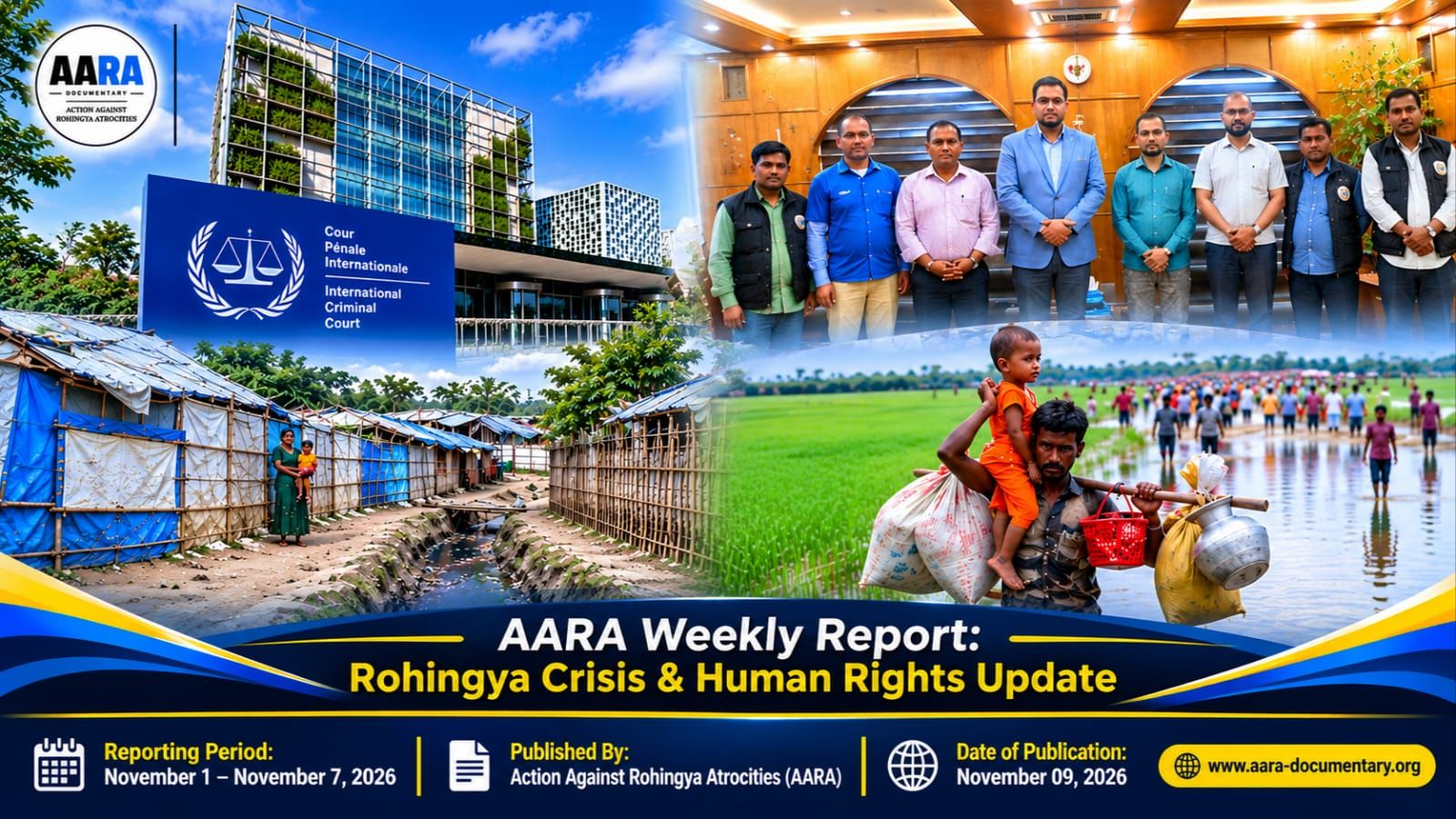
This week's report highlights the upcoming ICJ judgment in the Rohingya genocide case, calls for stronger international action, escalating violence in refugee camps, and continued persecution, arbitrary arrests, and torture of Rohingya in Rakhine State.
Executive Summary
This week has been marked by significant developments across diplomatic, legal, and security fronts concerning the Rohingya crisis. International engagement with Bangladesh on the Rohingya issue continues, with high-level visits and training sessions emphasizing the geopolitical complexities of the crisis. In a detailed interview, prominent Rohingya activist and former MP U Shwe Maung emphasized that the crisis is fundamentally political and called for a coordinated international framework for sustainable repatriation. A historic legal milestone is on the horizon as the International Court of Justice (ICJ) announced its final judgment date in the Rohingya genocide case.
However, on the ground in both Bangladesh and Myanmar, the situation remains dire. Inside the refugee camps in Cox's Bazar, a new Rohingya Gen-Z movement has issued a powerful call to end escalating armed violence and killings. Simultaneously, in Myanmar's Rakhine State, the Arakan Army (AA) has intensified its campaign of persecution against the Rohingya, conducting mass searches, arbitrary arrests, and committing acts of severe torture, including against a religious teacher. A Bangladeshi soldier was also killed in a clash with criminal gangs near a refugee camp, highlighting the security challenges in the region.
Key Developments This Week
1. International Engagement and Bangladesh's Policy Stance
• 115 Military Officers from Various Countries Visit RRRC Office to Study Rohingya Issue (Nov 1): A delegation of 115 military officers from the National Defence Course-2026, representing various countries, visited the RRRC office in Cox's Bazar. RRRC Commissioner Mohammad Mizanur Rahman briefed them on the crisis, emphasizing Bangladesh's position that the only acceptable durable solution is the "voluntary, safe, dignified, and sustainable return" of Rohingya to Myanmar. He called for sustained international engagement to address the root causes of the crisis in Myanmar.
• RRRC Discusses Rohingya Issue and Bangladesh’s Geopolitical Interests with 525 Trainees (Nov 2): Commissioner Mizanur Rahman addressed 525 government employee trainees at the Bangladesh Public Administration Training Centre (BPATC). The discussion focused on the geopolitical, strategic, and national interests shaping Bangladesh's response to the Rohingya crisis, aiming to deepen the trainees' understanding of the complex diplomatic and administrative challenges involved.
2. Political Analysis and International Advocacy
• "The Rohingya issue is not merely a humanitarian problem but a political one," says AiPAH head U Shwe Maung (Nov 7): In an interview with Agamir Somoy news outlet, U Shwe Maung, President and CEO of the Arakan Institute for Peace and Human Rights (AiPAH) and former Member of Parliament, provided a comprehensive political analysis of the Rohingya crisis.
Key points from the interview:
• Root Cause: U Shwe Maung emphasized that the Rohingya issue is fundamentally a political problem, not merely a refugee or identity issue. He stated that labeling Rohingya as "Bengali" is a deliberate method to deny their ethnic identity, citizenship rights, and equal rights in their ancestral Rakhine land.
• Bangladesh's Role: He urged Bangladesh to go beyond its role as a host country and exercise stronger diplomatic leadership. He recommended that Bangladesh bring together the UN, US, UK, EU, ASEAN, China, India, and other influential countries to establish an international cooperation framework for safe, voluntary, dignified, and sustainable repatriation.
• Conditions for Repatriation: Bangladesh should demand recognition of the Rohingya as an ethnic group, full citizenship rights, equal rights, security, and meaningful political representation as essential conditions for sustainable repatriation. He also suggested exploring the possibility of establishing a safe zone under international protection.
• ASEAN's Failure: U Shwe Maung criticized ASEAN's inaction, noting that five years have passed since the Five-Point Consensus was adopted, yet Myanmar's crisis continues. He called on Bangladesh to work closely with Malaysia, Indonesia, and other concerned ASEAN member states to build a regional diplomatic coalition.
• Situation in Rakhine State: He stated that a change in who controls territory alone will not bring peace, the way people are governed must also change. He called for an immediate halt to attacks on civilians, unimpeded humanitarian access, and the establishment of a safe zone under international monitoring.
• NUG's Commitment: While acknowledging that the National Unity Government (NUG) has publicly recognized Rohingya identity and pledged citizenship rights, U Shwe Maung stated that pledges alone are not enough. He emphasized that the real test is what NUG is ready to do for Rohingya today, not what it promises after the military dictatorship falls.
• Message to Rohingya Youth: He urged the new generation to never give up their ethnic identity, history, and rightful place in Rakhine land. He encouraged them to use education, research, writing, and modern technology to make their voices heard, build unity, and pursue political rights through peaceful means.
3. Escalating Violence and Insecurity in Rohingya Camps,
• Rohingya Gen-Z Demands End to Violence and Killings in Cox’s Bazar Refugee Camps (Nov 1): A newly formed Rohingya Gen-Z movement issued a statement strongly condemning the recent spike in killings, bloodshed, and armed violence within the refugee camps. The statement, which is "not against anyone, but only against violence," called for an immediate end to all forms of violence and demanded that the Bangladesh government and law enforcement authorities conduct thorough, impartial investigations to hold perpetrators accountable.
• Bangladesh Soldier Killed in Clash with Robber Gang in Teknaf (Nov 5): A Bangladeshi soldier was killed, and a Border Guard Police member was seriously injured during a military area clearance operation in the Mousoni Hills of Teknaf. The clash occurred with a gang known for robbery, human trafficking, and kidnapping Rohingya refugees for ransom. This incident underscores the severe security threats emanating from criminal networks that operate near and within the camps.
4. Legal Milestone for Justice and Accountability
• ICJ to Deliver Judgment in Rohingya Genocide Case on November 19 (Nov 4): The International Court of Justice (ICJ) announced it will deliver its judgment on November 19, 2026, in the genocide case filed by The Gambia against Myanmar. This landmark case, now with 11 intervening countries, will be a critical moment in the long struggle for justice and accountability for the Rohingya people.
5. Continued Persecution of Rohingya in Myanmar
• AA Conducts House-to-House Searches and Arrests in Rohingya Villages (Nov 4): Reports from Rakhine State indicate that the Arakan Army (AA) is conducting systematic house-to-house and mosque searches in Rohingya villages across Mrauk-U, Minbya, and Kyauktaw townships. These searches are accompanied by arbitrary arrests on various pretexts, and a restrictive system of recommendation letters is severely hampering the freedom of movement for Rohingya, even for medical emergencies.
• AA Severely Tortures and Arrests Mosque Teacher in Maungdaw (Nov 2): In a brutal incident, AA members and an affiliated ULA member dragged a 33-year-old mosque teacher, Mawlawi Salim, out of a mosque during prayers and subjected him to severe, inhumane torture before taking him away in a near-death condition. His current whereabouts and condition remain unknown.
AARA Observation and Analysis
The events of this week paint a stark picture of a crisis at a critical juncture. The international community's engagement, as seen in the visits to the RRRC, is crucial, but it must translate into tangible pressure on the Myanmar military and the Arakan Army. U Shwe Maung's interview provides a clear and comprehensive roadmap for a political solution, emphasizing that humanitarian assistance alone will not resolve the crisis. His call for Bangladesh to take a more assertive diplomatic role and for the international community to establish a coordinated framework for repatriation deserves serious consideration.
The violence within the refugee camps is a deeply alarming trend. AARA echoes the Rohingya Gen-Z movement's demand for an end to the bloodshed and for the Government of Bangladesh to take decisive action to protect vulnerable refugees from armed groups and criminal syndicates. The death of a Bangladeshi soldier is a tragic reminder of the heavy price paid by Bangladesh for its generosity.
The upcoming ICJ judgment is a beacon of hope. AARA believes that this ruling, regardless of its specifics, will be a powerful tool in the fight against impunity. It will reinforce the global call for justice and serve as a legal foundation for future accountability mechanisms.
As U Shwe Maung powerfully stated, "We are not demanding a new homeland. We are only demanding the right to live with equal rights and dignity in our ancestral Rakhine land, and to regain our rightful place." This fundamental truth must guide all international efforts.
AARA Calls for Action
1. To the International Community:
• Adopt a Political Approach: Move beyond treating the Rohingya crisis solely as a humanitarian issue. Recognize it as a political problem requiring a political solution, as emphasized by U Shwe Maung.
• Intensify Pressure: Impose targeted sanctions and arms embargoes on the Myanmar military and the Arakan Army to compel them to cease atrocities and create conditions conducive to the Rohingya's safe return.
• Support Justice: Unconditionally support the ICJ process and all other international accountability mechanisms. The pursuit of justice for the Rohingya is inseparable from the struggle for democracy and human rights for all people in Myanmar.
• Establish Protection Mechanisms: Take the lead in establishing credible international protection and monitoring arrangements in Rakhine State, and explore the possibility of creating a safe zone under international protection.
• Increase Humanitarian Funding: Scale up humanitarian assistance for both Rohingya refugees in Bangladesh and those displaced inside Myanmar to prevent further suffering.
2. To the Government of Bangladesh:
• Exercise Stronger Diplomatic Leadership: As recommended by U Shwe Maung, bring together the UN, US, UK, EU, ASEAN, China, India, and other influential countries to establish an international cooperation framework for sustainable repatriation.
• Demand Political Rights: Demand recognition of the Rohingya as an ethnic group, full citizenship rights, equal rights, security, and meaningful political representation as essential conditions for sustainable repatriation.
• Ensure Camp Security: Take immediate and effective measures to disarm criminal gangs and armed groups operating within the refugee camps. Investigate all incidents of violence transparently and hold perpetrators accountable to restore safety and security for all refugees.
• Uphold Refugee Rights: Ensure that the rights of Rohingya refugees are protected, and that any repatriation process is strictly voluntary, safe, and dignified, and conducted only when conditions in Myanmar are verifiably secure.
3. To the Arakan Army (AA):
• Cease Persecution: Immediately halt all forms of violence, torture, arbitrary arrests, and restrictions on movement against the Rohingya population in Rakhine State. Respect international humanitarian law and human rights norms.
4. To the National Unity Government (NUG):
• Demonstrate Genuine Commitment: Move beyond public statements and take concrete actions on the ground to protect Rohingya communities, allow Rohingya representatives to participate in political decision-making, and present a clear plan for restoring citizenship rights.
5. To Rohingya Youth:
• Preserve Identity and Pursue Justice: As U Shwe Maung advised, never give up your ethnic identity, history, and rightful place in Rakhine land. Use education, research, writing, and modern technology to make your voices heard. Build unity, raise capable young leaders, and continue to pursue your political rights through peaceful means, organized movements, and sustained, persistent effort.
AARA will continue to monitor the situation closely and advocate for the rights, dignity, and justice of the Rohingya people.
Latest news
AARA Welcomes ICJ Final Judgment Finding Myanmar Military Committed Genocide Against Rohingya
Court orders Myanmar to stop violence, allow safe return, restore rights, pay compensation, and punish perpetrators
Habi Rahman: Nearly Five Years in Prison and a Long Journey to Reunite with His Wife
After nearly five years in prison and years of separation, 69-year-old Habi Rahman reunited with his wife in Bangladesh, carrying memories of loss and hope for a safe return home.
Arakan Army’s Actions Against Rohingya May Amount to Crimes Against Humanity
International human rights lawyer Ashley S. Kinseth argues that the Arakan Army’s restrictions, forced labor, taxation, and land confiscation targeting Rohingya warrant investigation as possible crimes against humanity, including ethnic persecution, and calls for greater international accountability.
AARA Alleges 51 Rohingya Civilians Detained, Elderly Man Killed in Rathedaung Township by Militant Arakan Army (AA)
Rohingya villagers face urgent concerns over a reported deadline imposed by the militant Arakan Army (AA) to leave their homes by October 17, 2026, raising fears of further displacement and loss of shelter.