AARA Welcomes ICJ Final Judgment Finding Myanmar Military Committed Genocide Against Rohingya
Court orders Myanmar to stop violence, allow safe return, restore rights, pay compensation, and punish perpetrators
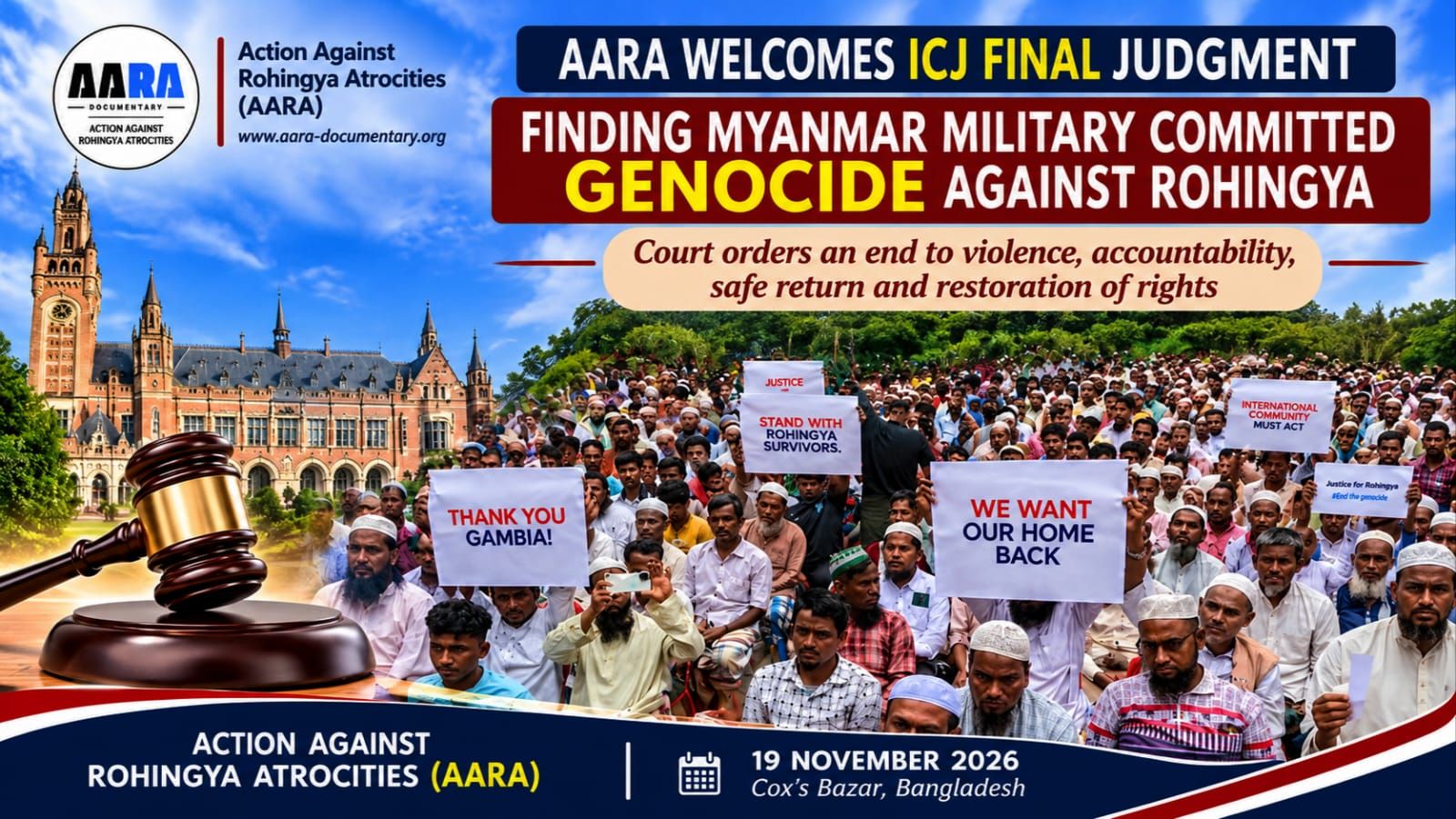
Action Against Rohingya Atrocities (AARA) welcomes and publishes the International Court of Justice (ICJ)’s final judgment that the Myanmar military, led by Min Aung Hlaing, committed genocide against the Rohingya in northern Rakhine State. The Hague-based Court issued the final ruling today, November 19.
According to the judgment, the ICJ decided by a vote of 9 to 6 that Myanmar committed genocide against the Rohingya ethnic group in northern Rakhine State.
Reading the final judgment, Court President Yuji Iwasawa said that after comprehensively reviewing all the evidence, the only reasonable conclusion capable of explaining Myanmar’s actions was that the Court found Myanmar had acted with the intent to destroy a substantial part of the Rohingya group.
“The Court finds that Myanmar’s security forces killed thousands of Rohingya civilians, committed sexual violence on a widespread scale, committed extremely cruel acts of violence against young children, and also attacked Rohingya who were attempting to flee mass killings to Bangladesh,” the Court President said.
The Court’s judgment also stated that about 10,000 Rohingya were killed during the military’s 2017 clearance operations.
The Court decided that Myanmar’s actions violated provisions of the 1948 Convention on the Prevention and Punishment of the Crime of Genocide. It also pointed out that Myanmar had created obstacles to efforts to investigate genocide and had failed to punish perpetrators of genocide.
The Court’s final conclusion stated that the evidence showed Myanmar’s actions were carried out with the intent to destroy a part of the Rohingya group. Therefore, the Court’s judgment made clear that the military’s stated reasons, counter-insurgency and clearance operations, did not match the actions actually committed on the ground.
The case was first filed against Myanmar in 2019 by Gambia, a West African country. Gambia brought it to the Court alleging that Myanmar had committed acts intended to destroy the Rohingya group and had violated the Genocide Convention.
Gambia requested that the illegal acts being committed against Rohingya be stopped; that perpetrators of genocide be held accountable and punished; that compensation and remedies be provided to victims; and that Rohingya who had been displaced be enabled to return safely and with dignity.
Regarding the return of Rohingya, Gambia’s requested remedies also included allowing displaced persons to return safely and resettle; restoring their homes, land, and other property; and removing restrictions on freedom of movement and residence and on earning a livelihood.
During the military’s 2017 operation, more than 730,000 Rohingya fled to Bangladesh. Currently, more than 1.3 million Rohingya remain displaced in South and Southeast Asian countries. According to UN data, about 1.2 million of them are sheltering in refugee camps in Cox’s Bazar, Bangladesh.
Myanmar has a legal obligation to comply with the ICJ’s final judgment.
The ICJ’s final judgment today is the first time the Court has confirmed and decided that Myanmar is a country that committed genocide in relation to the Rohingya genocide.
U Nay San Lwin, co-chair of the Arakan Rohingya National Council (ARNC), said today that the ICJ’s decision is a historic day for Rohingya.
“Today is a historic day for the Rohingya people, and also a victory for the basic principle that no country should be above international law. I especially thank Gambia, which stood firmly on our side while most other countries were silent, the 11 countries that intervened, and the OIC. But a court judgment alone will not fully deliver justice. Myanmar must implement the Court’s orders without delay and take action so that perpetrators are held responsible and accountable. For Rohingya, justice means regaining our citizenship, having our existence as a people recognized, and being able to return safely and with dignity to our original homes. Until that day comes, our efforts and struggle will continue.”
Additional Reaction from Community Leader
Mulvi Swayed Ullah, Former First President of UCR and President of the Panel of the United Council of Rohingya (UCR), also welcomed the judgment and stated:
“We are the ethnic minority from Myanmar. We have different culture, religion, and characteristics, and the ICJ clearly stated that. From today, when the ICJ court orders that we are Rohingya, if anyone calls us ‘Bangali,’ then by following international law, action will be taken. We are fully satisfied by the court. But in the future, we cannot go home by this satisfaction alone. Today’s ICJ judgment, we can implement it by working actively for the community, not only through media, civil society, government, agencies, Rohingya relevant actors, Rohingya activists, and leaders. We all need to work in one policy cooperation to implement today’s ICJ judgment. From today, international pressure on Myanmar will be high.”
AARA’s Position
AARA reiterates that Myanmar must implement the ICJ’s orders without delay. AARA calls for:
- An immediate end to all violence and persecution against Rohingya;
- Accountability for all perpetrators of genocide and atrocity crimes;
- Restoration of Rohingya citizenship and recognition of Rohingya identity;
- Safe, dignified, and voluntary return of displaced Rohingya to their original homes;
- Restoration of homes, land, and property;
- Removal of restrictions on movement, residence, and livelihood; and
- Full compensation and rehabilitation for victims.
AARA stands with the Rohingya people and with all partners working to ensure that the Court’s judgment is translated into real justice on the ground.
This article reflects AARA’s statement and advocacy position. Legal findings are attributed to the ICJ judgment and statements cited in this report.
Latest news
AARA Welcomes ICJ Final Judgment Finding Myanmar Military Committed Genocide Against Rohingya
Court orders Myanmar to stop violence, allow safe return, restore rights, pay compensation, and punish perpetrators
Habi Rahman: Nearly Five Years in Prison and a Long Journey to Reunite with His Wife
After nearly five years in prison and years of separation, 69-year-old Habi Rahman reunited with his wife in Bangladesh, carrying memories of loss and hope for a safe return home.
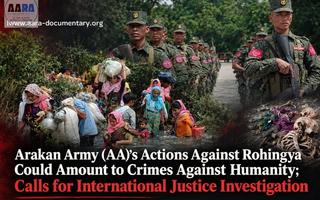
Arakan Army’s Actions Against Rohingya May Amount to Crimes Against Humanity
International human rights lawyer Ashley S. Kinseth argues that the Arakan Army’s restrictions, forced labor, taxation, and land confiscation targeting Rohingya warrant investigation as possible crimes against humanity, including ethnic persecution, and calls for greater international accountability.

AARA Alleges 51 Rohingya Civilians Detained, Elderly Man Killed in Rathedaung Township by Militant Arakan Army (AA)
Rohingya villagers face urgent concerns over a reported deadline imposed by the militant Arakan Army (AA) to leave their homes by October 17, 2026, raising fears of further displacement and loss of shelter.