September 2026 Rohingya Situation Report: Forced Recruitment, Displacement and Abuses in Rakhine
AARA’s weekly report documents forced recruitment, severe restrictions, displacement, violence, and worsening humanitarian conditions affecting Rohingya communities in Rakhine and Bangladesh.
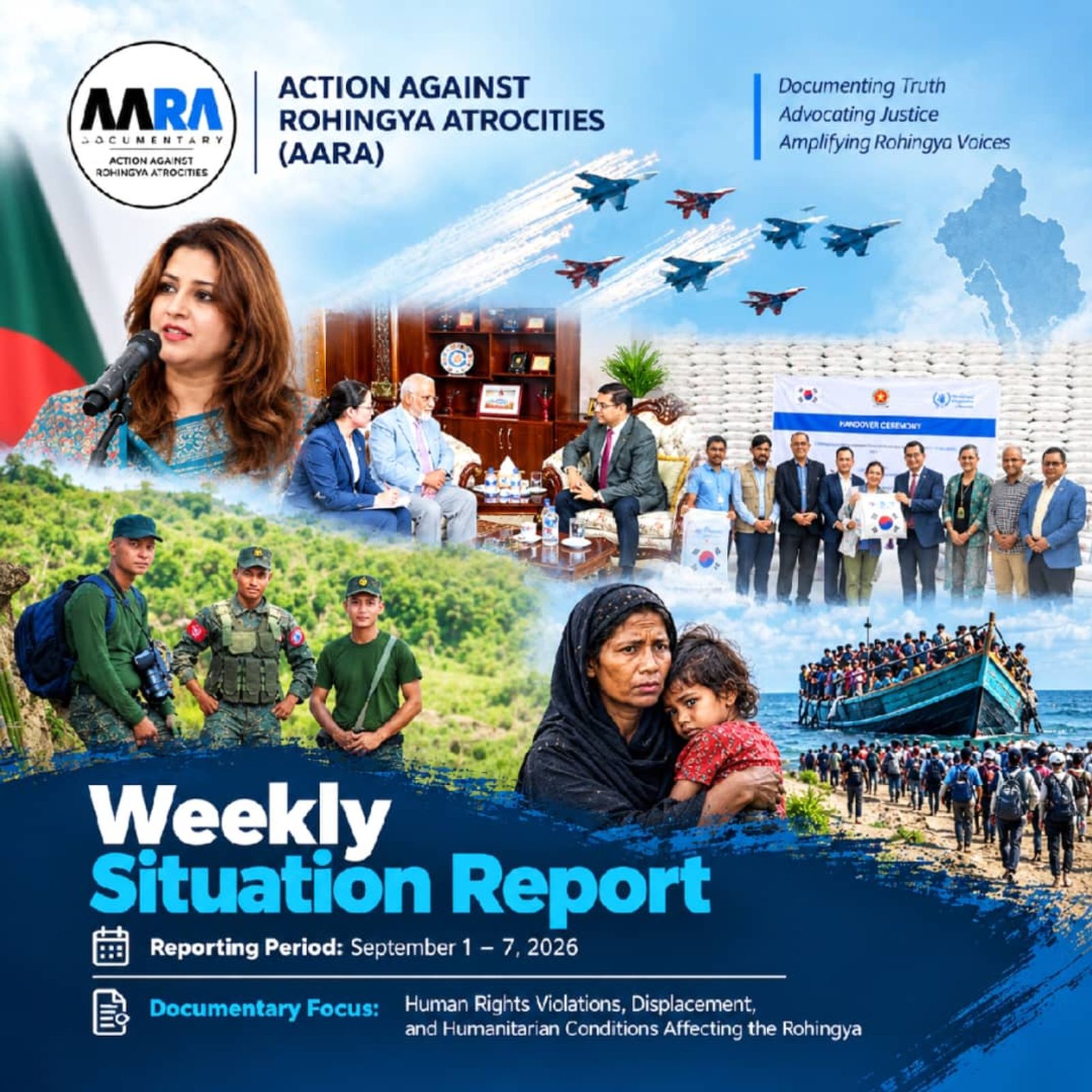
Weekly Situation Report
1. EXECUTIVE SUMMARY
This week's documentation reveals a rapidly deteriorating situation for Rohingya communities in both Bangladesh and Myanmar. Key findings include:
• Forced recruitment of Rohingya by both the Myanmar military and the Arakan Army (AA), as confirmed by the UN's IIMM.
• Severe movement restrictions, extortion, and violence by AA forces in northern Rakhine, creating a "suffocating" humanitarian crisis with famine-like conditions.
• Diplomatic pressure on Malaysia to halt the planned deportation of nearly 1,500 Myanmar refugees.
• International humanitarian support from South Korea and ongoing diplomatic engagement by Japan.
• Ongoing military offensives in Rakhine State, causing mass displacement and civilian casualties.
2. KEY DOCUMENTED INCIDENTS
A. Forced Recruitment of Rohingya as Soldiers (Myanmar/(Arakan (Rakhine) )
• Date: September 7, 2026
• Source: IIMM Chief Nicholas Koumjian at the United Nations
· Details: Both the Myanmar military junta and the Arakan Army (AA) are forcibly recruiting Rohingya civilians, including from displacement camps, to serve as soldiers. The military junta activated the People's Military Service Law in early 2024. The IIMM warns that Rohingya are being used on the front lines, facing severe human rights violations with no safe place to flee.
B. AA Imposes Suffocating Restrictions and Conducts Sweeps in Rohingya Villages (Maungdaw, Arakan (Rakhine) )
• Date: September 2, 2026
•Source: Local sources in Maungdaw
•Details: The AA/ULA is using ARSA as a pretext to impose severe restrictions on Rohingya:
- Travel bans and strict checks.
- Livelihood restrictions: Ban on cattle grazing and fishing in the Naf River.
- Extortion: Arbitrary taxation and money extortion.
- Violence: Nightly sweeps, arbitrary arrests, beatings of civilians (including the elderly), forced labor, and forced conscription of youth.
- Occupation: AA troops are occupying civilian homes (two- and three-story buildings).
- Humanitarian Impact: Local Rohingya are facing a famine crisis, with some eating only one meal a day or every two days. People are fleeing abroad daily.
C. Arbitrary Arrest of Rohingya Traders (Maungdaw, Arakan (Rakhine) )
• Date: September 3, 2026
• Source: Eyewitnesses
• Details: AA forces arrested two ordinary Rohingya betel leaf traders from Buthidaung at the Kyikanpyin checkpoint. The traders had purchased betel leaves with AA's permission but were arrested on charges of transporting "illegal goods." Locals note that drugs can be legally possessed if taxes are paid to AA, highlighting a contradictory and predatory legal system.
D. Military Offensive and Mass Displacement (Rathedaung Township, Arakan (Rakhine) )
• Date: September 4-5, 2026
• Source: Local residents and AA/ULA statements
• Details: The Myanmar military launched a combined land, sea, and air assault on Agn Ngu Maw village (AA-controlled) in Rathedaung Township. Navy warships and aircraft bombarded the area for hours. Locals reported "the ground shook as if the world was collapsing." Villagers fled, and coastal communities are being urgently relocated.
E. Pressure on Rohingya Education (Kyauktaw Township, Arakan (Rakhine) )
Date: September 4, 2026
Source: Local sources and education officials
- Details: The AA/ULA's new education policies are jeopardizing access to education for Muslim children. Reports include:
- Mandatory fees (10,000–30,000 kyats per student) for the 2026-27 academic year.
- Pressure on independent "Laypya Education Charity" study circles, which provide non-formal modern education.
- A complaint submitted to the Arakan National Party chairman has received no response.
3. DIPLOMATIC AND POLICY DEVELOPMENTS
A. UNHCR Urges Malaysia to Reconsider Deportation
• Date: September 1, 2026
•Details: UNHCR urged Malaysia to reconsider its plan to repatriate 1,476 Myanmar refugees (including Rohingya) on September 29. UNHCR states it is not involved and cannot guarantee their safety, as Myanmar remains a country at war. Over 193,800 Myanmar nationals are registered with UNHCR in Malaysia.
B. Bangladesh Pushes for Faster Verification
• Date: September 7, 2026
• Details: Deputy Foreign Minister Shama Obaed Islam stated that the Rohingya verification process must not become an "endless administrative process." She called for accelerated verification based on existing bilateral agreements. She also warned that declining international funding is making it increasingly difficult for Bangladesh to shoulder its humanitarian responsibilities.
C. Japan's Diplomatic Engagement
• Date: September 7, 2026
• Details: Dr. Yohei Sasakawa, Japan's Special Envoy for Myanmar, visited Bangladesh and met with Prime Minister Tarique Rahman. Discussions focused on safe, voluntary, and dignified Rohingya repatriation. Japan pledged continued support, though Sasakawa warned that progress may be slow due to the complex situation in Rakhine.
D. Myanmar Military Council's Statement
• Date: September 3, 2026
• Details: Myanmar's Ministry of Foreign Affairs issued a statement rejecting international criticism of the 2017 events, blaming ARSA for the violence and defending its security forces' actions. It reiterated its willingness to cooperate with Bangladesh on repatriation but objected to the use of the term "Rohingya."
4. HUMANITARIAN RESPONSE
South Korea Provides Food Aid
• Date: September 6, 2026
• Details: South Korea donated 15,000 tons of rice and 150 tons of nutrient-fortified rice grains to Rohingya refugees in Cox's Bazar, Bangladesh. This is in addition to previous donations in 2024 and 2025. WFP warned that needs continue to exceed available resources.
5. AARA ANALYSIS & RECOMMENDATIONS
Key Trends:
- Militarization of the Rohingya: Both warring parties are treating Rohingya as a resource for forced recruitment, exposing them to extreme danger.
- Systematic Strangulation: The AA's restrictions on movement, livelihoods, and trade in northern Arakan (Rakhine) are creating man-made famine conditions.
- Accountability Gap: Despite ongoing documentation by the IIMM, there is no immediate mechanism for justice or protection.
- Diplomatic Fatigue: International funding is declining, and diplomatic efforts are yielding slow progress on the ground.
AARA Recommendations:
1. Urgent Humanitarian Corridor: Demand unimpeded access for aid agencies to northern Rakhine to prevent mass starvation.
2. Document and Expose Forced Recruitment: Collect testimonies from escapees and families to build a case for international prosecution.
3. Pressure Malaysia: Amplify UNHCR's call to halt deportations to a conflict zone.
4. Support Education: Provide emergency funding and protection for independent Rohingya education initiatives facing pressure from the AA.
5. Advocate for Accountability: Continue to support the IIMM and ICJ processes as essential components of a sustainable solution.
Prepared by: Action Against Rohingya Atrocities (AARA)
Date of Report: September 12, 2026
Sources: Bay of Bengal Post, The Straits Times, Dhaka Tribune, Bangladesh Ministry of Foreign Affairs, Local Contacts in Rakhine, UN Statements.
Latest news

AARA Alleges 51 Rohingya Civilians Detained, Elderly Man Killed in Rathedaung Township by Militant Arakan Army (AA)
Rohingya villagers face urgent concerns over a reported deadline imposed by the militant Arakan Army (AA) to leave their homes by October 17, 2026, raising fears of further displacement and loss of shelter.
1,500 Myanmar Nationals Deported from Malaysia Aboard Junta Warships Amid Airstrike Horror
Malaysia has begun deporting around 1,500 Myanmar nationals despite ongoing conflict, forced conscription risks, and warnings that safe and dignified return remains impossible.
August 25 and the Hindu Massacre Narrative: How the Arakan Army Is Shifting Blame Toward Rohingya and ARSA
The article examines how the Arakan Army's August 25, 2026 Hindu commemoration presents the 2017 Hindu massacre as an ARSA crime, raising questions over efforts to shift blame onto Rohingya and reshape the history of the Rohingya genocide.