AARA Weekly Analysis Human Rights Violations in AA Control in Rakhine and Chin States Reporting Period | 8–14 Jun 2026
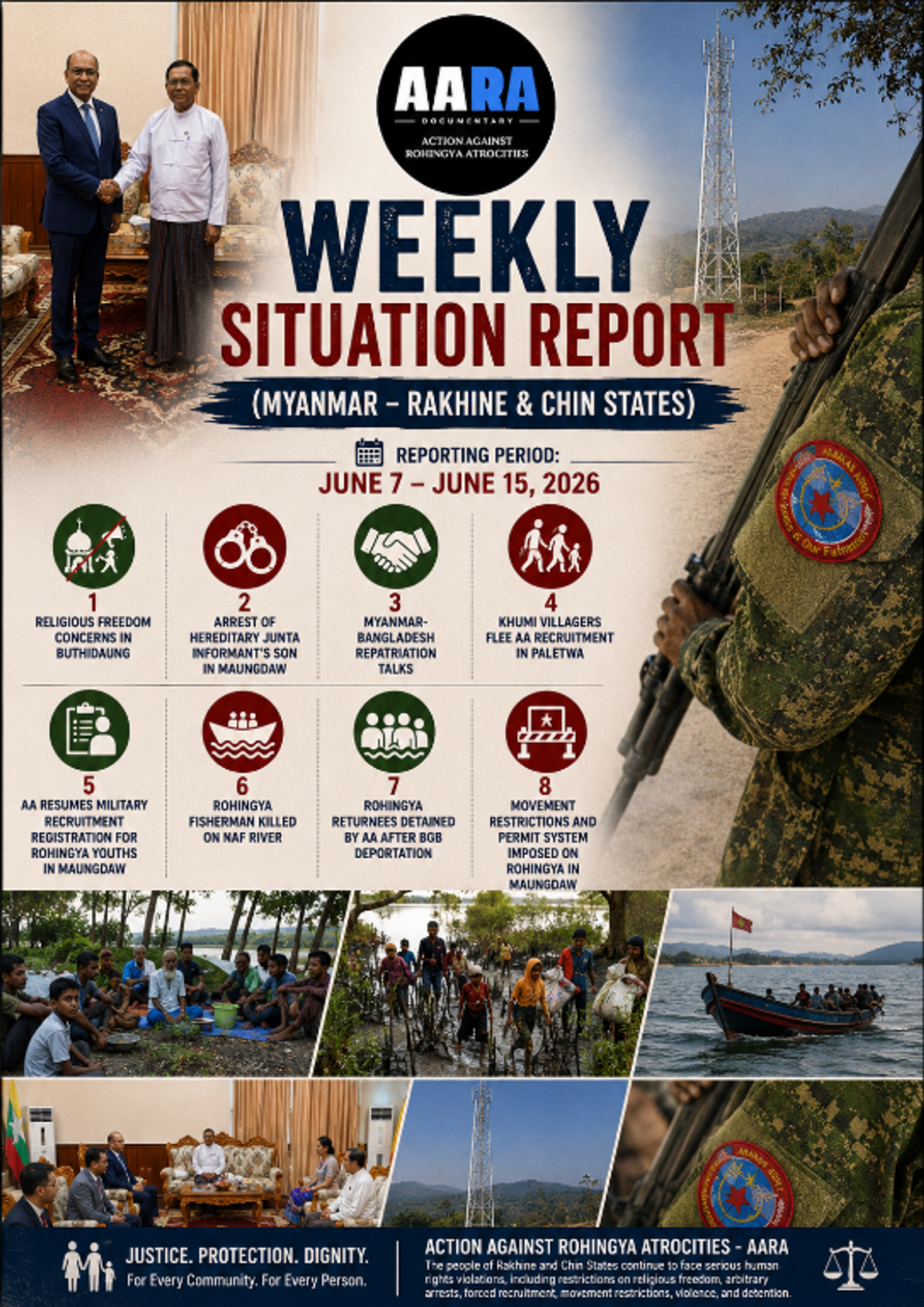
During 8–14 June 2026, AARA documented growing restrictions on religious freedom, renewed military recruitment of Rohingya youth, arbitrary detention, movement restrictions, and deadly violence affecting Rohingya civilians in Rakhine State, alongside the displacement of Khumi communities in Chin State due to forced conscription practices. The findings reveal a worsening human rights situation under Arakan Army control.
Executive Summary
This report provides an independent analysis and contextual assessment of the findings documented in the Action Against Rohingya Atrocities (AARA) Weekly Special Report covering the period 8–14 June 2026. The evidence gathered during this period points to a troubling pattern of escalating repression, discriminatory policies, forced recruitment, arbitrary detention, and restrictions on fundamental freedoms affecting Rohingya communities in northern Rakhine State, as well as ethnic Khumi civilians in neighboring Chin State.
Independent reporting and corroborating information from multiple sources support many of the incidents documented by AARA and demonstrate broader patterns of governance emerging under the control of the Arakan Army (AA) and the United League of Arakan (ULA).
Particularly concerning are increasing restrictions on religious practices, renewed military recruitment campaigns targeting vulnerable communities, movement restrictions that undermine access to healthcare and livelihoods, and incidents involving arbitrary detention and violence against civilians. Collectively, these developments contribute to an environment of fear, insecurity, and institutionalized discrimination.
1. Restrictions on Religious Freedom in Buthidaung and Maungdaw Townships
One of the most alarming developments documented during the reporting period concerns restrictions imposed on Islamic religious practices.
According to local sources, the AA/ULA prohibited the use of loudspeakers for the Azan (Islamic call to prayer) in mosques across Buthidaung Township. Similar restrictions were subsequently reported in Maungdaw Township, where warnings and intimidation allegedly led mosque authorities to discontinue the use of loudspeakers.
AA authorities reportedly justified the measure by claiming that the sound of the Azan resembled that of an aircraft. Community members and observers have widely rejected this explanation, describing it as arbitrary and lacking legitimate justification.
Reports further indicate unequal treatment between religious communities. While Muslim worshippers have faced restrictions, Buddhist monasteries reportedly continue using amplification systems for sermons, and loud public music by local Rakhine youths remains unrestricted. Such selective implementation raises serious concerns regarding discrimination and unequal protection of religious rights.
From the perspective of international human rights law, these measures are incompatible with protections guaranteed under Article 18 of the Universal Declaration of Human Rights (UDHR) and the International Covenant on Civil and Political Rights (ICCPR), both of which safeguard freedom of religion and the right to manifest religious beliefs in practice and observance.
The absence of transparency, proportionality, and equal application raises significant concerns regarding the legality and legitimacy of these restrictions.
2. Forced Recruitment and Displacement
Renewed Recruitment Targeting Rohingya Youth
Beginning on 6 June 2026, the Arakan Army reportedly resumed the registration of Rohingya men and women between the ages of 18 and 30 in several villages across Maungdaw Township.
Families were instructed to provide household documentation for the compilation of recruitment lists. Residents expressed deep concern regarding the fate and whereabouts of previously recruited individuals, about whom limited information has been provided.
Parents fear that military recruitment will interrupt education, restrict opportunities for higher learning, and negatively affect the long-term economic prospects of young people. Reports indicate that some families are considering displacement to avoid conscription.
The recruitment of civilians under coercive conditions raises serious concerns under international humanitarian and human rights law, particularly where informed consent and legal protections are absent.
Displacement of Khumi Civilians in Chin State
The impact of forced recruitment has extended beyond Rohingya communities.
Forty-seven ethnic Khumi civilians from Shinmadin and Kuwa villages in Paletwa Township reportedly fled into Bangladesh after house-to-house arrest campaigns allegedly conducted for recruitment purposes.
According to local sources, there was no active fighting in the area at the time, indicating that displacement occurred primarily because of fears of forced conscription rather than direct armed conflict.
The incident demonstrates that concerns surrounding coercive recruitment under AA administration affect multiple ethnic communities and have increasingly assumed a cross-border humanitarian dimension.
3. Violence and Arbitrary Detention
Attack on Rohingya Fishermen on the Naf River
Reports indicate that on 6 June 2026, armed members of the Arakan Army allegedly opened fire on a fishing boat carrying Rohingya refugees near the Waikhong border area on the Naf River.
The attack reportedly resulted in the death of Mohammad Faruk, while another refugee, Mohammad Anu, sustained serious injuries. Two individuals remain missing.
Although independent verification of the incident remains limited, previous reports concerning violence along the Naf River suggest a broader pattern of insecurity affecting border communities.
Detention of Vulnerable Rohingya Returnees
Sixteen Rohingya civilians including women, elderly persons, and nursing infants were reportedly detained by AA forces after being deported from Bangladesh.
The group had attempted to cross the Naf River but were intercepted by Bangladeshi authorities and returned to Myanmar. After re-entering the country under severe weather conditions, they were detained and transferred to Pyin Phyu Chaung Wa camp.
The presence of elderly individuals and infants among those detained raises significant humanitarian concerns and highlights the vulnerability of displaced populations trapped between borders.
Arrest of Ibrahim in Paungza Village
The arrest of Ibrahim, son of a former military collaborator and local administrator under AA rule, has generated considerable public attention.
Residents accused him of extortion, abuse of authority, intimidation, and involvement in the fabrication of criminal charges against community members. Villagers have questioned why allegations against him remained unaddressed for an extended period and have called for an impartial investigation and accountability.
The case reflects broader concerns regarding transparency, corruption, and unequal application of justice within local administrative structures.
4. Tightening Restrictions on Freedom of Movement
Rohingya communities in Maungdaw Township continue to face severe limitations on their freedom of movement.
Residents reportedly require multiple recommendation letters and approvals from village and township authorities before entering Maungdaw town. Checkpoints frequently deny passage to individuals lacking the necessary documentation.
Community members further reported unofficial fees, repeated visits to administrative offices, and prolonged delays caused by absent officials.
These restrictions have significantly affected access to healthcare, employment opportunities, markets, and basic services, thereby aggravating existing humanitarian and economic hardships.
Freedom of movement constitutes a fundamental right recognized under international human rights law. Restrictions that are discriminatory, arbitrary, or economically exploitative undermine both human dignity and civilian welfare.
5. Diplomatic and International Context
Myanmar–Bangladesh Repatriation Discussions
On 9 June 2026, representatives of Myanmar and Bangladesh held discussions concerning the repatriation of Rohingya refugees displaced since the 2017 atrocities.
While both sides reaffirmed their commitment to cooperation and verification processes, ongoing reports of discrimination, insecurity, and restrictions under AA control raise serious questions regarding the feasibility of safe, voluntary, dignified, and sustainable repatriation.
Without guarantees of equal rights, freedom of movement, and protection from persecution, conditions remain unfavorable for meaningful returns.
International Scrutiny of Arakan Army Governance
As the Arakan Army consolidates control over most of Rakhine State, increasing attention is being directed toward its governance practices and treatment of minority communities.
Reports by international human rights organizations and discussions within United Nations mechanisms have heightened scrutiny over allegations involving massacres, forced recruitment, movement restrictions, and discriminatory policies.
The AA's aspirations for political legitimacy and international recognition will inevitably be judged by its adherence to international humanitarian law and its treatment of ethnic and religious minorities under its authority.
Persistent patterns of abuse challenge narratives portraying the organization as a responsible governing actor and underscore the need for independent monitoring and accountability mechanisms.
Conclusion
The findings documented during the reporting period reveal a deteriorating human rights environment in Rakhine and Chin States under Arakan Army control.
Restrictions on religious freedom, coercive recruitment, arbitrary detention, violence against civilians, and severe movement limitations collectively demonstrate a pattern of governance that disproportionately affects vulnerable communities, particularly the Rohingya population.
These developments not only violate internationally recognized human rights standards but also threaten regional stability and undermine prospects for voluntary refugee repatriation and long-term peace.
As the Arakan Army seeks increased legitimacy and political influence, adherence to international humanitarian principles and the protection of minority rights must become central benchmarks for assessing its conduct.
Action Against Rohingya Atrocities (AARA) urges international organizations, United Nations mechanisms, regional actors, humanitarian agencies, and concerned governments to intensify monitoring efforts, strengthen protection mechanisms for affected populations, and promote accountability for ongoing violations in Rakhine and Chin States.
Related articles
Latest news
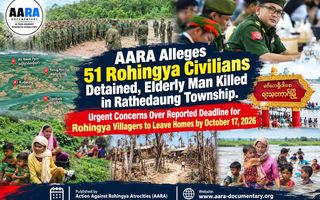
AARA Alleges 51 Rohingya Civilians Detained, Elderly Man Killed in Rathedaung Township by Militant Arakan Army (AA)
Rohingya villagers face urgent concerns over a reported deadline imposed by the militant Arakan Army (AA) to leave their homes by October 17, 2026, raising fears of further displacement and loss of shelter.
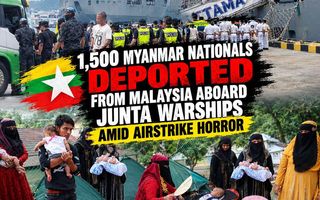
1,500 Myanmar Nationals Deported from Malaysia Aboard Junta Warships Amid Airstrike Horror
Malaysia has begun deporting around 1,500 Myanmar nationals despite ongoing conflict, forced conscription risks, and warnings that safe and dignified return remains impossible.
August 25 and the Hindu Massacre Narrative: How the Arakan Army Is Shifting Blame Toward Rohingya and ARSA
The article examines how the Arakan Army's August 25, 2026 Hindu commemoration presents the 2017 Hindu massacre as an ARSA crime, raising questions over efforts to shift blame onto Rohingya and reshape the history of the Rohingya genocide.