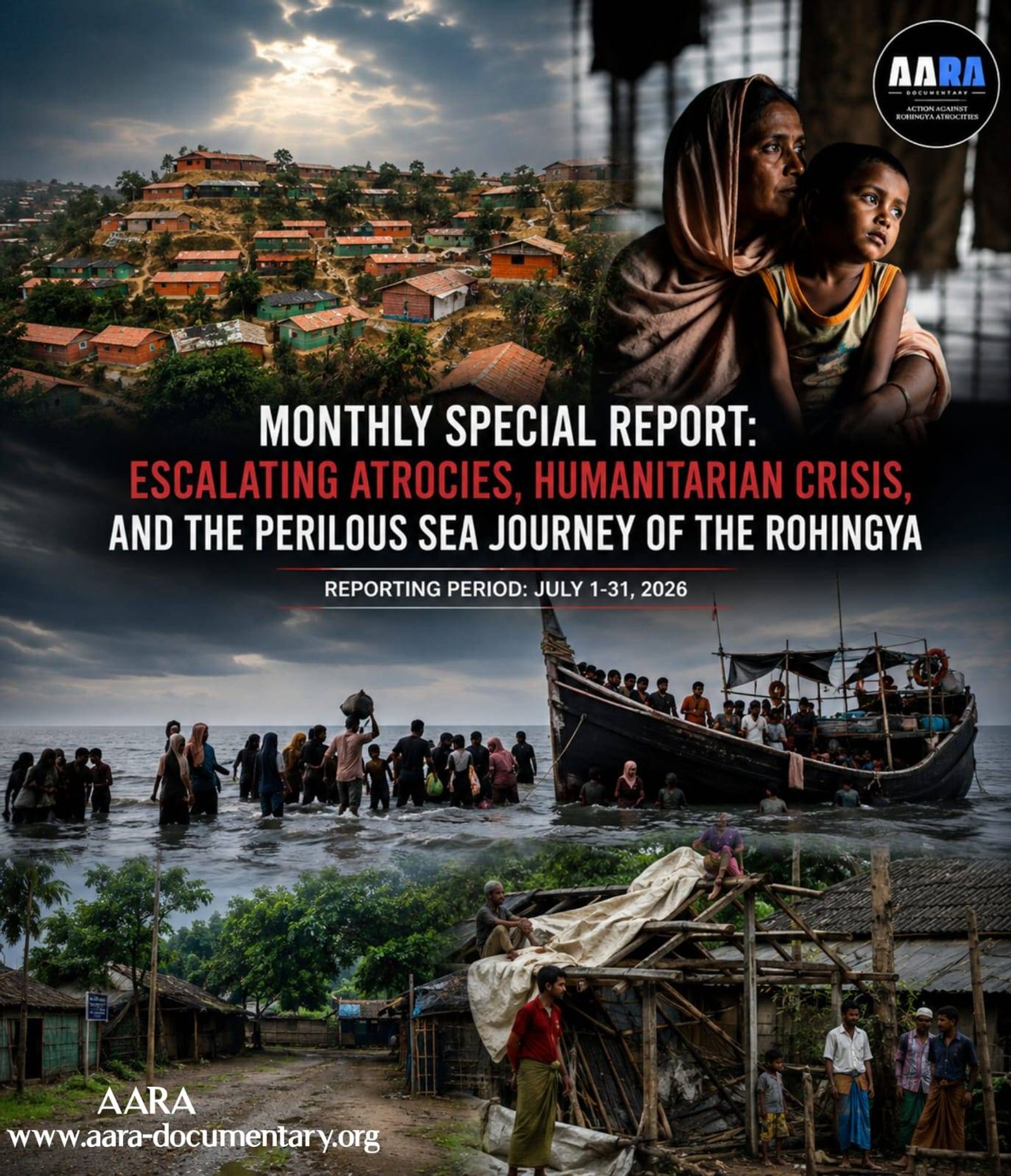
AARA Monthly Special Report: Escalating Atrocities and the Rohingya Humanitarian Crisis (July 2026)
This report documents the major developments affecting the Rohingya during July 2026, highlighting a sharp escalation in armed conflict, human rights abuses, and humanitarian suffering in Arakan (Rakhine) State, Myanmar, and the Rohingya refugee camps in Bangladesh. It examines intensified aerial bombardments by the Myanmar military junta, increasing restrictions and abuses against Rohingya under the Arakan Army's control, deadly maritime tragedies linked to human trafficking networks, and the devastating impact of monsoon flooding on vulnerable communities. The report concludes with urgent recommendations calling for the protection of Rohingya civilians, expanded humanitarian access, accountability for violations of international law, and coordinated international action to address the worsening crisis.
Executive Summary
The month of July 2026 witnessed a catastrophic escalation in violence, humanitarian suffering, and systemic exploitation targeting the Rohingya people in Arakan (Rakhine) State, Myanmar, as well as in the refugee camps across the border in Bangladesh. Following significant territorial losses to the Arakan Army (AA), the Myanmar military junta intensified its aerial campaign, deploying heavy ordnance including 500-pound bombs against densely populated civilian villages. These indiscriminate attacks resulted in numerous civilian casualties, including children and other vulnerable populations.
At the same time, the Arakan Army, now exercising de facto control over approximately 14 of the 17 townships in Rakhine State, has increasingly imposed systemic restrictions, arbitrary detentions, and financial extortion upon the Rohingya population, further deepening their longstanding marginalization and insecurity.
Compounding the violence on land, July 2026 was marked by a devastating surge in maritime tragedies. More than 500 Rohingya are feared dead after at least three overcrowded boats capsized in the Andaman Sea and the Bay of Bengal while attempting to reach Malaysia. These tragedies driven by the activities of human trafficking networks allegedly operating with the involvement of local armed actors underscore the desperate circumstances confronting a population trapped between relentless military bombardment and systematic exploitation by armed groups.
Meanwhile, persistent monsoon rains throughout the month submerged dozens of villages, destroyed homes and essential infrastructure, and triggered a severe humanitarian crisis, leaving thousands without adequate shelter, food, or access to clean water.
Action Against Rohingya Atrocities (AARA) categorizes these escalating developments as systemic atrocities requiring urgent and coordinated international action, including immediate humanitarian access, meaningful protection for civilians, and the cessation of hostilities by all armed parties.
I. Escalating Military Aggression and Aerial Bombardments
Throughout July 2026, the Myanmar military junta carried out relentless aerial bombardments across at least eight townships in Arakan State, including Maungdaw, Buthidaung, Gwa, and Mrauk-U. Employing fighter aircraft and Y-12 military aircraft, these attacks deliberately targeted civilian infrastructure, residential neighborhoods, and flood-affected communities, constituting grave violations of international humanitarian law.
On July 1 and 2, the junta launched coordinated airstrikes in Buthidaung and Maungdaw, dropping heavy bombs near civilian villages, including Wachila and Kyauk Mauk Taung. The attacks severely injured multiple children and destroyed numerous homes.
In one particularly disturbing incident on July 2, junta aircraft bombed a prisoner-of-war detention camp in Kyeinchaung Village, killing four detainees, including one junta captain and three soldiers who were being held by the Arakan Army. This apparent "kill-all" tactic reflects a deliberate strategy of indiscriminate destruction, carried out without regard for military necessity or the fundamental principles of distinction and proportionality under international law.
By mid-July, the military expanded its aerial campaign into southern Rakhine. On July 13, fighter jets bombed three villages in Gwa Township for more than an hour. The offensive intensified further on July 19 and 20, when the junta conducted eight waves of airstrikes against Mrauk-U Township, dropping approximately 100 bombs near Kyauk Kyat Village. During the same period, military aircraft also targeted the No. 2 Police Station in Thandwe, injuring civilians and Buddhist monks.
| Date | Location | Incident Description | Casualties / Impact |
| July 1 | Buthidaung | Coordinated airstrikes on civilian villages using heavy ordnance | Multiple children injured; approximately 10 homes destroyed |
| July 2 | Maungdaw | Bombing of a prisoner-of-war detention camp | Four detainees killed, including junta personnel |
| July 19 | Thandwe | Airstrikes targeting the Police Station and Township Court | Four civilians injured; residential houses damaged |
| July 20 | Mrauk-U | Seven aircraft dropped approximately 100 bombs in eight attack waves | Widespread terror; residents forced to flee their villages |
These sustained aerial assaults inflicted not only immediate civilian casualties and widespread destruction but also served as a deliberate instrument of psychological warfare. Communities already devastated by severe flooding and collapsing infrastructure were subjected to repeated bombardment, forcing thousands of civilians into renewed displacement and deepening an already catastrophic humanitarian crisis.
II. The Perilous Sea Journey: Trafficking and Maritime Disasters
Perhaps the most catastrophic development of July 2026 was the immense loss of Rohingya lives at sea. Trapped between relentless military persecution in Myanmar and worsening hardship in the refugee camps of Bangladesh, thousands of Rohingya continued to undertake perilous maritime journeys in search of safety and dignity.
During July 2026 alone, it is estimated that more than 500 Rohingya perished in separate maritime tragedies in the Andaman Sea and the Bay of Bengal. On June 29 and July 7, two overcrowded boats carrying a combined total of more than 530 Rohingya departed from Sintakmaw, Pauktaw Township, Rakhine State, bound for Malaysia, before capsizing amid rough monsoon conditions. By the end of July, more than 20 bodies had washed ashore in Taungup and Sittwe, while hundreds of others remained missing and are presumed dead.
These devastating incidents underscore the deadly expansion of human trafficking networks operating throughout Arakan State. Investigative findings indicate that these maritime routes are controlled by brokers who allegedly collude with elements of the Arakan Army (AA). Rohingya refugees including individuals from refugee camps in Bangladesh are transported to holding camps in Pauktaw, where they are subjected to extortion before being forced onto overcrowded and unseaworthy vessels, often during dangerous monsoon weather.
"People do not risk their lives at sea unless the alternatives are even more unbearable. Decades of persecution, statelessness, conflict and severe humanitarian hardship have left many with nowhere safe to turn."Amnesty International Myanmar Researcher, July 16, 2026 [8]
The scale of mortality associated with these sea crossings is unprecedented. During 2025, nearly 900 Rohingya were reported dead or missing at sea, making it the deadliest year on record. Tragically, 2026 has witnessed the continuation of this alarming trend. According to UNHCR, the mortality rate for Rohingya attempting maritime crossings has reached approximately one death for every seven people undertaking the journey the highest fatality rate recorded among refugee sea routes worldwide.
These recurring maritime disasters are not isolated accidents but the direct consequence of prolonged persecution, statelessness, armed conflict, systematic exploitation, and the continued absence of safe, legal, and dignified pathways to protection. As long as these underlying drivers remain unaddressed, the Andaman Sea and the Bay of Bengal will continue to serve as deadly escape routes for desperate Rohingya families seeking refuge.
III. Governance by the Arakan Army: Extortion and Arbitrary Detentions
While the Myanmar military junta bears the primary responsibility for decades of systematic persecution of the Rohingya, including the 2017 genocide, the Arakan Army (AA) through its de facto control over 14 of Rakhine State's 17 townships has introduced new and deeply concerning vulnerabilities for the Rohingya population.
Human rights organizations, including Amnesty International and Fortify Rights, have documented that the Rohingya remain trapped between the junta's continued denial of citizenship and the Arakan Army's imposition of severe movement restrictions, arbitrary detentions, forced labor, and other coercive practices. Rather than improving civilian protection, the changing territorial landscape has left the Rohingya exposed to additional forms of exploitation and abuse.
Throughout July 2026, multiple incidents highlighted the AA's coercive practices against Rohingya civilians.
In Maungdaw Township, officials of the United League of Arakan/Arakan Army (ULA/AA) required every Rohingya household to contribute to a so-called "national fund," effectively institutionalizing the financial extortion of a community that has already been deprived of its livelihoods and economic security.
Similarly, in Rathedaung Township, Rohingya households in Thamyar Hla Village Tract were arbitrarily ordered to pay 7,000 kyats per household to finance bridge repairs. The levy significantly exceeded the actual funding required for the project and imposed an unsustainable financial burden on already impoverished families struggling to meet their basic needs.
The Arakan Army also continued its pattern of arbitrary detention.
On July 22, AA soldiers arrested Mohammedura Rahman, a 33-year-old Rohingya civilian in Maungdaw Township, based on unsubstantiated allegations that he had assisted fleeing Myanmar military soldiers. Following his arrest, the AA imposed severe movement restrictions in areas near the Bangladesh border, effectively halting fishing activities and cross-border trade. These restrictions caused food prices to rise sharply, further worsening an already critical food security situation for Rohingya communities.
Collectively, these measures reflect a broader pattern of collective punishment directed at the Rohingya population. Financial extortion, arbitrary detention, and sweeping movement restrictions continue to undermine livelihoods, restrict access to essential services, and deepen the humanitarian crisis facing an already persecuted and marginalized community.
Although the Myanmar military junta remains principally responsible for the systematic persecution of the Rohingya, all parties exercising effective control over civilian populations are bound by international humanitarian and human rights law. The continued imposition of coercive measures against Rohingya civilians further erodes their safety, dignity, and fundamental rights, while perpetuating an environment of fear, insecurity, and discrimination.
IV. The Monsoon Humanitarian Catastrophe
The ongoing armed conflict has been compounded by a severe humanitarian emergency triggered by the 2026 monsoon season. Beginning in early July 2026, relentless rainfall caused widespread flooding across at least 10 of Rakhine State's 17 townships, affecting nearly 100,000 people and further intensifying an already fragile humanitarian situation.
In Minbya Township, at least 22 villages, including four predominantly Rohingya settlements, were completely submerged following the overflow of the Laymyo River. The flooding washed away roads, isolated entire communities, and severely damaged essential infrastructure, including drinking water tanks in Kyauktaw, leaving thousands without reliable access to safe drinking water and other basic services.
For the Rohingya, whose freedom of movement remains severely restricted and whose homes are often constructed on vulnerable, deforested hillsides in both Rakhine State and the refugee camps in Bangladesh, the monsoon season represents an existential threat. Recurrent flooding, landslides, and collapsing infrastructure continue to place already displaced and marginalized communities at grave risk.
According to Human Rights Watch, landslides in the Cox's Bazar refugee camps during July 2026 killed at least 17 Rohingya refugees and displaced thousands more. The organization attributed the scale of the devastation to the chronic shortage of humanitarian funding for camp stabilization and the continued prohibition on constructing permanent, weather-resistant shelters.
"The deadly risks facing Rohingya refugees... are evident from landslides... These are not simply natural disasters, but a predictable outcome of policies that put refugees' lives at risk."
Meenakshi Ganguly, Human Rights Watch, July 13, 2026 [24]
The humanitarian consequences of the monsoon extend far beyond immediate physical destruction. Flooding has disrupted access to food, clean water, healthcare, education, and humanitarian assistance, while damaged roads and communications infrastructure have hindered relief operations in many affected areas.
For Rohingya communities already living under conditions of conflict, displacement, and systemic discrimination, the monsoon has transformed a humanitarian emergency into a multidimensional crisis. Without sustained humanitarian assistance, adequate disaster preparedness, and unrestricted access for relief agencies, thousands of vulnerable families will remain exposed to preventable loss of life, disease outbreaks, and further displacement.
V. Urgent Recommendations and Calls to Action
Action Against Rohingya Atrocities (AARA) urges the international community, the United Nations, regional actors, and all relevant stakeholders to take immediate, coordinated, and decisive action in response to the escalating violence and deepening humanitarian catastrophe affecting the Rohingya throughout July 2026.
1. Immediate Cessation of Airstrikes
The Myanmar military junta must immediately cease all aerial bombardments targeting civilian populations, residential areas, and civilian infrastructure in Arakan State. The deliberate use of heavy ordnance in densely populated areas constitutes a grave violation of international humanitarian law and may amount to a war crime.
2. Combat Human Trafficking and Strengthen Maritime Rescue Operations
The international community, including ASEAN and the governments of Malaysia and Indonesia, must establish and strengthen robust search-and-rescue operations across the Bay of Bengal and the Andaman Sea to prevent further loss of life. Immediate action must also be taken to dismantle the human trafficking networks operating in Rakhine State, including conducting independent investigations into the alleged involvement of local armed actors.
3. Protect the Rights of Rohingya Civilians
The Arakan Army (AA) must immediately cease the arbitrary collection of funds, extortionate levies, arbitrary detentions, and other coercive measures targeting Rohingya communities. The Rohingya must not be subjected to collective punishment, discrimination, or exploitation under any circumstances.
4. Ensure Unfettered Humanitarian Access
Donor governments, United Nations agencies, and humanitarian organizations must ensure safe, rapid, and unrestricted humanitarian access to all conflict- and flood-affected areas throughout Rakhine State. Funding for monsoon-related disaster preparedness, emergency response, and humanitarian assistance in both Myanmar and the Rohingya refugee camps in Bangladesh must be urgently restored and expanded to prevent further catastrophic loss of life.
5. Ensure Accountability
Independent, impartial, and credible investigations must be initiated into the July 2026 maritime disasters, as well as the ongoing violations and abuses committed against the Rohingya by both the Myanmar military junta and the Arakan Army. Individuals responsible for war crimes, crimes against humanity, and other serious violations of international law must be held accountable through appropriate international legal mechanisms.
Conclusion
The events documented throughout July 2026 demonstrate that the Rohingya continue to endure one of the world's most severe and protracted human rights and humanitarian crises. Intensified aerial bombardments by the Myanmar military junta, coercive practices imposed by the Arakan Army, recurring maritime tragedies fueled by human trafficking networks, and the devastating impact of the monsoon season have collectively compounded the suffering of an already persecuted and stateless people.
The convergence of armed conflict, systemic discrimination, forced displacement, environmental disaster, and shrinking humanitarian space has left the Rohingya facing unprecedented levels of insecurity and vulnerability. Without immediate international action, strengthened civilian protection, meaningful humanitarian access, and credible accountability for ongoing violations, the crisis will continue to deepen, placing countless more lives at risk.
Action Against Rohingya Atrocities (AARA) calls upon the international community to move beyond expressions of concern and undertake concrete, coordinated, and sustained measures to protect the Rohingya people, uphold international law, and advance justice, accountability, and a future founded on dignity, safety, and fundamental human rights.
Related articles
AARA Monthly Special Report: Escalating Atrocities and the Rohingya Humanitarian Crisis (July 2026)
This report documents the major developments affecting the Rohingya during July 2026, highlighting a sharp escalation in armed conflict, human rights abuses, and humanitarian suffering in Arakan (Rakhine) State, Myanmar, and the Rohingya refugee camps in Bangladesh. It examines intensified aerial bombardments by the Myanmar military junta, increasing restrictions and abuses against Rohingya under the Arakan Army's control, deadly maritime tragedies linked to human trafficking networks, and the devastating impact of monsoon flooding on vulnerable communities. The report concludes with urgent recommendations calling for the protection of Rohingya civilians, expanded humanitarian access, accountability for violations of international law, and coordinated international action to address the worsening crisis.
AARA Monthly Report: Escalating Human Rights Violations Against Rohingya in Rakhine State | June 2026
Action Against Rohingya Atrocities (AARA)'s Monthly Special Report | June 2026 documents escalating human rights violations against Rohingya communities across Rakhine State, Myanmar, and along the Bangladesh–Myanmar border. The report details patterns of extortion, forced displacement, land confiscation, arbitrary detention, forced conscription, restrictions on freedom of movement, and attacks on civilians, including shelling and airstrikes. It also highlights continued cross-border displacement into Bangladesh and the worsening humanitarian situation. AARA calls on the international community to ensure accountability, strengthen civilian protection, expand humanitarian assistance, and support the safe, voluntary, and dignified return of Rohingya refugees in accordance with international law.
AARA Monthly Report: Escalating Human Rights Violations Against Rohingya in Rakhine State | June 2026
Action Against Rohingya Atrocities (AARA)'s Monthly Special Report | June 2026 documents escalating human rights violations against Rohingya communities across Rakhine State, Myanmar, and along the Bangladesh–Myanmar border. The report details patterns of extortion, forced displacement, land confiscation, arbitrary detention, forced conscription, restrictions on freedom of movement, and attacks on civilians, including shelling and airstrikes. It also highlights continued cross-border displacement into Bangladesh and the worsening humanitarian situation. AARA calls on the international community to ensure accountability, strengthen civilian protection, expand humanitarian assistance, and support the safe, voluntary, and dignified return of Rohingya refugees in accordance with international law.
Latest news

AARA Alleges 51 Rohingya Civilians Detained, Elderly Man Killed in Rathedaung Township by Militant Arakan Army (AA)
Rohingya villagers face urgent concerns over a reported deadline imposed by the militant Arakan Army (AA) to leave their homes by October 17, 2026, raising fears of further displacement and loss of shelter.
1,500 Myanmar Nationals Deported from Malaysia Aboard Junta Warships Amid Airstrike Horror
Malaysia has begun deporting around 1,500 Myanmar nationals despite ongoing conflict, forced conscription risks, and warnings that safe and dignified return remains impossible.
August 25 and the Hindu Massacre Narrative: How the Arakan Army Is Shifting Blame Toward Rohingya and ARSA
The article examines how the Arakan Army's August 25, 2026 Hindu commemoration presents the 2017 Hindu massacre as an ARSA crime, raising questions over efforts to shift blame onto Rohingya and reshape the history of the Rohingya genocide.