AARA Weekly Special Report: Escalating Human Rights Violations Against Rohingya in Rakhine State | 15–21 June 2026
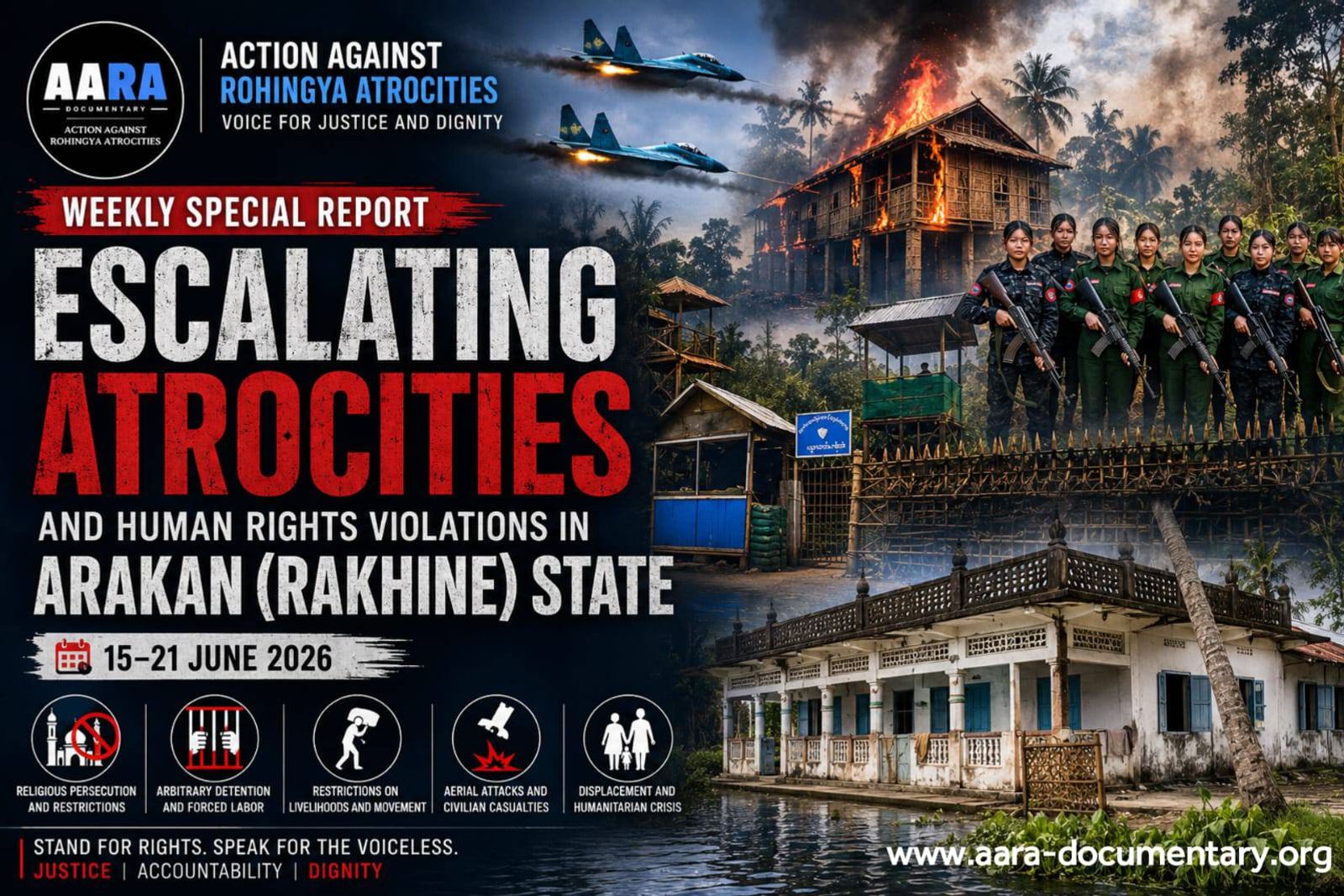
During the reporting period, Rohingya communities in Rakhine State continued to face serious human rights violations, including restrictions on religious freedom, arbitrary detention, forced labor, and severe limitations on movement and livelihoods. Reports indicate that the Arakan Army (AA) maintained restrictions on the Islamic call to prayer (Adhan) and continued the use of seized religious buildings for military and administrative purposes. Meanwhile, the Myanmar military junta intensified aerial attacks on civilian-populated areas, causing civilian casualties, injuries, and destruction of homes and businesses. The ongoing violence has further driven displacement, with more than 152,000 Rohingya having fled to Bangladesh since late 2024. The report highlights the urgent need for civilian protection, humanitarian access, accountability for violations, and adherence to international human rights and humanitarian law by all parties to the conflict.
I. Executive Summary
During the reporting period of 15–21 June 2026, Rohingya communities across Arakan (Rakhine) State, Myanmar, continued to face serious human rights violations and protection concerns amid ongoing armed conflict and administrative control exercised by the Arakan Army (AA). Simultaneously, the Myanmar military junta intensified aerial attacks in civilian-populated areas, resulting in further civilian casualties, destruction of property, and displacement.
Information collected by Action Against Rohingya Atrocities (AARA) indicates a pattern of restrictions affecting freedom of religion, allegations of arbitrary detention, forced labor, severe limitations on livelihoods and freedom of movement, and the reported misuse of religious sites for military and administrative purposes. These developments have compounded existing vulnerabilities faced by the Rohingya population and contributed to a deteriorating humanitarian situation throughout northern Rakhine State.
The reporting period was also marked by continued displacement into Bangladesh, where humanitarian agencies continue to face significant challenges responding to the needs of newly arrived refugees. The cumulative impact of armed conflict, discriminatory restrictions, economic marginalization, and insecurity has further undermined the safety, dignity, and fundamental rights of affected communities.
II. Religious Persecution and Restrictions on Freedom of Worship
During the reporting period, the Arakan Army (AA) continued restrictions affecting Islamic religious practices in Buthidaung Township and Maungdaw Township.
Local residents reported that authorities maintained an indefinite prohibition on the use of loudspeakers for the Islamic call to prayer (Adhan) in mosques throughout Buthidaung Township. According to community sources, AA officials justified the restriction by claiming that the sound of the Adhan resembled an aircraft. The restriction reportedly remains in effect across mosques in both Buthidaung and Maungdaw.
Community members and local observers expressed concern that the policy disproportionately targets Rohingya Muslims. While mosques remain prohibited from broadcasting the Adhan, reports indicate that Buddhist monasteries continue to use loudspeakers for sermons and religious activities. Residents also reported that local Rakhine youth are permitted to use amplified sound systems without comparable restrictions.
Observers and community representatives have characterized these measures as discriminatory and inconsistent with the right to freedom of religion or belief, including the right to manifest one's religion through worship, observance, and religious practice.
III. Alleged Violations of International Humanitarian Law
Information received during the reporting period indicates that Rohingya religious buildings and civilian properties have been used for military and administrative purposes in areas under AA control.
Conversion of Religious Buildings
In U Hla Pe Village, local sources reported that a mosque has been converted into an AA administrative office and reportedly includes a detention facility. Residents stated that the local AA area commander operates from the site.
Use of Mosques for Recruitment Activities
In Uy Nyo Taung Village, four Rohingya mosques were reportedly seized and repurposed as recruitment centers for AA personnel.
Alleged Desecration of Religious Sites
Residents further reported that some seized religious buildings have been used for social gatherings involving alcohol consumption and recreational activities. Members of the Rohingya community described these actions as deeply offensive to their religious beliefs and cultural heritage.
The protection of religious and cultural property during armed conflict is recognized under international humanitarian law, including Article 53 of Additional Protocol I to the Geneva Conventions and the 1954 Hague Convention for the Protection of Cultural Property in the Event of Armed Conflict.
IV. Arbitrary Detention and Forced Labor
Reports received during the reporting period indicate continuing concerns regarding arbitrary detention and forced labor practices affecting Rohingya civilians.
Detention of a Civilian as a Proxy
On 16 June 2026, U Aziz Ullah, a 58-year-old Rohingya resident of northern Maungdaw Township, was reportedly detained by AA personnel.
According to local sources, he was taken in connection with allegations against his son, who currently resides in a refugee camp in Bangladesh. Community members reported that the detention was carried out as a form of proxy punishment. If confirmed, such practices would be inconsistent with fundamental principles of individual criminal responsibility and protections against arbitrary detention under international human rights law.
Forced Labor of Prisoners and Family Members
In Buthidaung Township, eyewitnesses reported that prisoners of war and their family members, including women and children, have been compelled to perform labor on public infrastructure and agricultural projects.
According to these accounts, individuals were required to work from 6:00 a.m. to 6:00 p.m., carrying out activities such as road construction, drainage clearing, and agricultural work. Witnesses further alleged that some individuals were restrained while working and received inadequate food, contributing to deteriorating physical conditions.
V. Restrictions on Livelihoods and Freedom of Movement
Rohingya residents in areas under AA administration continue to face significant restrictions affecting their economic activities and freedom of movement.
Economic Exclusion and Brokerage Requirements
Community members reported that Rohingya business owners are unable to operate independently and must conduct commercial activities through Rakhine intermediaries or obtain permits under the names of Rakhine nationals.
For the transportation and sale of natural resources, including bamboo and timber, Rohingya traders reportedly require authorization from AA authorities, creating barriers to independent economic activity.
Restrictions on Movement
Residents reported that travel within the township requires documentation issued by AA authorities. Individuals lacking such documentation face restrictions on movement.
The restrictions have reportedly affected access to forests and agricultural areas used for grazing livestock, collecting natural resources, and sustaining household livelihoods.
Restrictions on Trade and Imports
Local sources further reported that Rohingya residents are unable to directly import basic food items and consumer goods from other townships and must rely on intermediaries. Community members indicated that these restrictions have increased prices and reduced access to essential commodities.
VI. Myanmar Military Junta Aerial Campaign
The reporting period was marked by continued aerial attacks by the Myanmar military junta, resulting in civilian casualties and destruction of civilian property.
Kyauktaw Airstrikes (17–18 June 2026)
On 17 June 2026, military aircraft reportedly conducted a series of airstrikes on Kyauktaw Town, targeting multiple residential areas over approximately one hour.
Local reports indicated that at least eight civilians were killed and numerous homes and shops were destroyed or damaged.
By 18 June 2026, local sources reported that the number of civilians killed in and around Kyauktaw had risen to at least twelve, including women and children. Five deaths were reported within the town, while seven fatalities were reported in the nearby Lanmadaw area.
Escalation in Southern Rakhine State
On 20 June 2026, additional airstrikes were reported in Kyintali Town, Gwa Township, where two civilians were reportedly injured and civilian property was damaged.
According to figures cited by the National Unity Government (NUG), the Myanmar military has carried out more than 12,000 airstrikes since 2021, resulting in widespread civilian casualties and destruction of civilian infrastructure.
VII. Displacement and Humanitarian Crisis
The continuing conflict and insecurity in Rakhine State have contributed to ongoing displacement and increased humanitarian needs among Rohingya populations.
Vulnerable Populations
Women and children constitute approximately 78 percent of newly arrived refugees. Humanitarian actors have identified approximately 12 percent of the refugee population as particularly vulnerable, including elderly persons, persons with disabilities, individuals with serious medical conditions, and children requiring additional protection.
Refugee Population in Bangladesh
The total Rohingya refugee population residing in camps in Cox’s Bazar is estimated at approximately 1,197,411 people, placing continued pressure on humanitarian services and protection mechanisms.
VIII. Conclusion and Recommendations
The reporting period of 15–21 June 2026 was marked by continuing insecurity, discrimination, and civilian harm affecting Rohingya communities throughout Rakhine State.
Reports documented restrictions on religious practice, allegations of arbitrary detention and forced labor, limitations on livelihoods and movement, and continued aerial attacks in civilian-populated areas. At the same time, displacement into Bangladesh continued, further exacerbating humanitarian needs both within Myanmar and across the border.
Action Against Rohingya Atrocities (AARA) calls for:
1. The immediate removal of restrictions on religious practices and the return of all seized mosques and religious buildings to their intended civilian and community use.
2. Independent investigations into allegations of arbitrary detention, proxy punishment, and forced labor, with accountability established in accordance with international standards.
3. Immediate measures to protect civilians and civilian infrastructure from aerial attacks and other conflict-related harm.
4. Sustained humanitarian access and increased international assistance for Rohingya refugees in Bangladesh and conflict-affected populations within Myanmar.
5. Full compliance by all parties to the conflict with international humanitarian law and international human rights standards, including the protection of civilians, religious sites, and civilian property.
Related articles
AARA Weekly Analysis Human Rights Violations in AA Control in Rakhine and Chin States Reporting Period | 8–14 Jun 2026
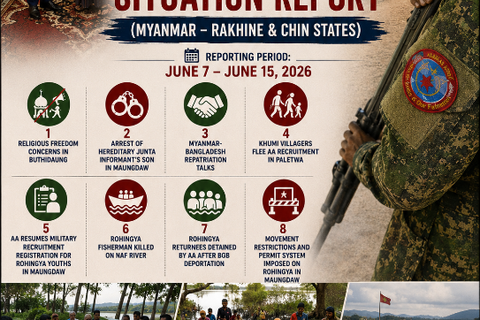
During 8–14 June 2026, AARA documented growing restrictions on religious freedom, renewed military recruitment of Rohingya youth, arbitrary detention, movement restrictions, and deadly violence affecting Rohingya civilians in Rakhine State, alongside the displacement of Khumi communities in Chin State due to forced conscription practices. The findings reveal a worsening human rights situation under Arakan Army control.
AARA' weekly documents escalating atrocities against the Rohingya and growing international calls for accountability.
AARA’s weekly report documents escalating human rights violations against the Rohingya in Rakhine State, including airstrikes, forced conscription, sexual violence, and economic extortion, while international calls for accountability continue to grow.
Latest news
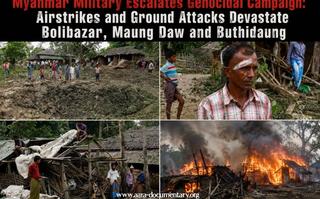
Myanmar Military Escalates Genocidal Campaign: Airstrikes and Ground Attacks Devastate Bolibazar and Buthidaung
On 1 July 2026, the Myanmar military launched coordinated airstrikes and ground attacks targeting Rohingya civilian areas in Maungdaw and Buthidaung townships, Rakhine State. The attacks struck Bolibazar village and several locations in Buthidaung, injuring civilians, including a child who lost a leg. **Action Against Rohingya Atrocities (AARA)** condemns these attacks as serious violations of international humanitarian law and calls for an immediate end to military operations against civilians, stronger international action, and unrestricted humanitarian access to affected communities.

Junta Air Force Bombs Maungdaw Town with Two Aerial Bombs
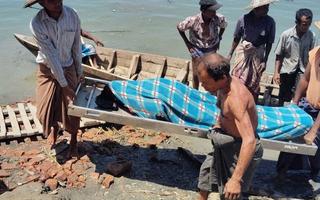
Report for Action Against Rohingya Atrocities (AARA): Minbya Boat Capsizing Incident
On 12 May 2026, an overcrowded boat carrying Rohingya villagers returning from a football match capsized in the Lay Myo River in Minbya Township, Rakhine State, killing 10 people, including an 8-year-old child. The tragedy underscores the dangerous conditions Rohingya communities face due to severe restrictions on freedom of movement, reliance on unsafe transportation, and heightened risks during the monsoon season. This incident reflects the broader humanitarian crisis confronting Rohingya in Rakhine State and the urgent need for unrestricted movement, safer transport, and increased humanitarian access.

CONDEMNING THE BRUTAL EXTRAJUDICIAL KILLING OF ROHINGYA YOUTHS BY THE ARAKAN ARMY (AA) IN NORTH MAUNGDAW
AARA strongly condemns the brutal extrajudicial killing of two Rohingya youths by the Arakan Army in Maungdaw. Arbitrarily detained while fishing, the victims were later found dead, showing clear signs of severe abuse. This atrocity reflects an escalating pattern of violence against Rohingya civilians. AARA urgently calls for an independent international investigation, accountability for perpetrators, and immediate protection for the Rohingya population.