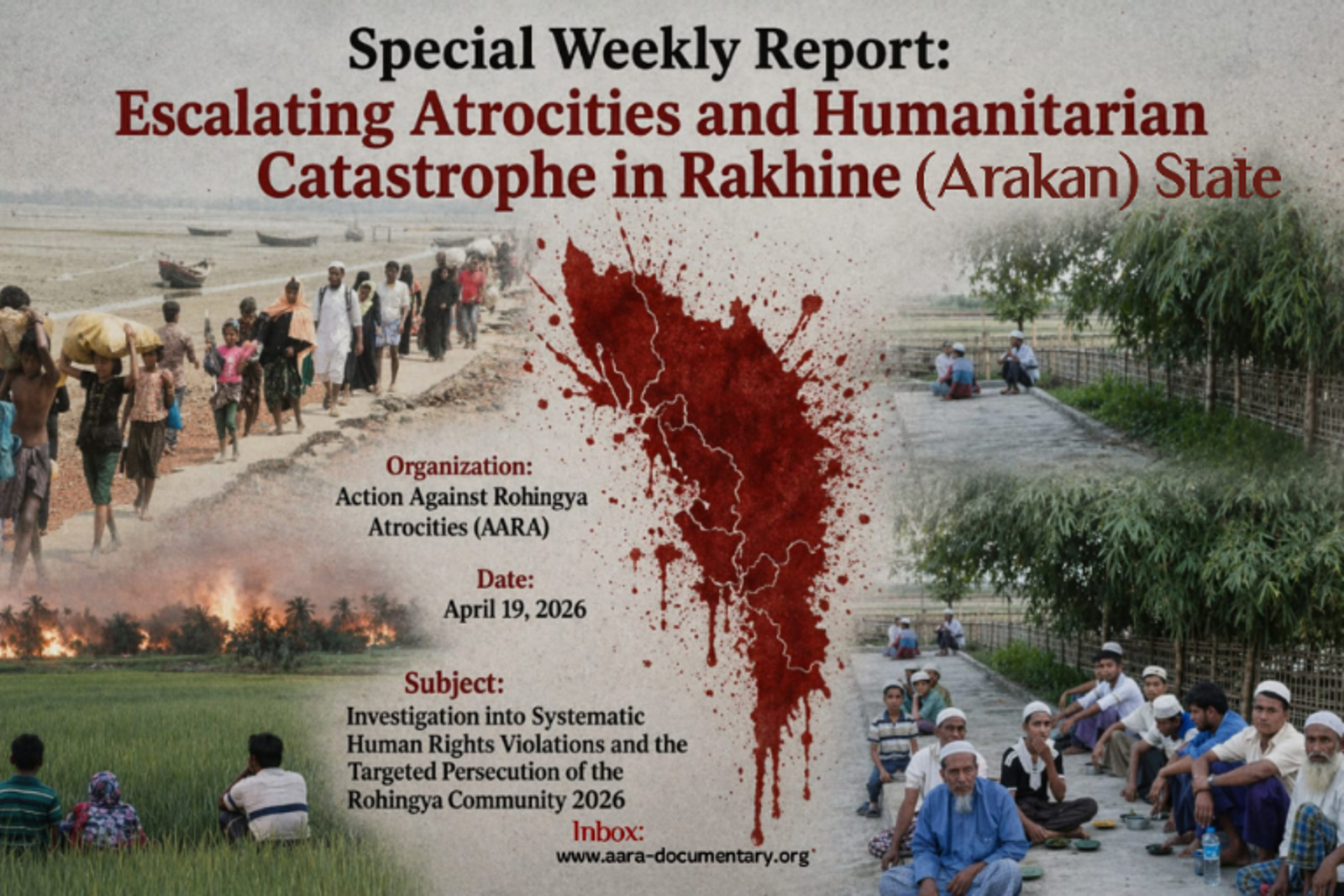
Special Weekly Report: Escalating Atrocities and Humanitarian Catastrophe in Arakan (Rakhine) State
Action Against Rohingya Atrocities (AARA) presents its Special Weekly Report (April 10–17, 2026), documenting a sharp escalation of violence and persecution against the Rohingya in Arakan (Rakhine) State. The report highlights credible evidence of mass killings, forced labor, economic exploitation, and severe humanitarian deterioration driven by aid cuts and movement restrictions. During the reporting period, new incidents further exposed patterns of abuse, including the shooting and arrest of a Rohingya religious teacher in northern Maungdaw and the release of 63 detainees from Buthidaung prison in extremely poor physical condition, indicating torture and ill-treatment. These developments reinforce concerns over systematic human rights violations and potential breaches of international humanitarian law. AARA calls for urgent international action, including expanded investigations, targeted sanctions, and immediate humanitarian support to protect the Rohingya population and ensure accountability.
Executive Summary
Action Against Rohingya Atrocities (AARA) presents this comprehensive report documenting a harrowing escalation of violence, systematic persecution, and a deepening humanitarian crisis targeting the Rohingya population in Myanmar’s Arakan (Rakhine) State and across the border in Bangladesh.
This analysis, grounded in verified testimonies and international human rights monitoring, highlights the dual threat posed by the Myanmar military junta and the Arakan Army (AA). Of particular concern is the emerging evidence of mass killings, forced labor, and the weaponization of basic survival needs through food aid cuts and extortionate taxation.
AARA calls upon the international community, specifically the International Criminal Court (ICC) and United Nations member states, to expand existing investigations and impose targeted sanctions to ensure accountability for these heinous crimes.
I. Evidence of Systematic Mass Killings: The Honyar Siri Massacre
New and compelling evidence has emerged regarding a large-scale massacre of Rohingya civilians committed by the Arakan Army (AA) in May 2024. This incident represents a significant expansion of the scope of atrocities, shifting from state-led genocide to targeted violence by ethnic armed organizations.
Incident Detail
Category & Description
Location: Honyar Siri (Thay Chaung Kha / Htan Shauk Khan), Buthidaung Township
Date of Incident: May 2, 2024
Perpetrator: Arakan Army (AA)
Nature of Crime: Mass execution of fleeing civilians, including women and children
Legal Status: Petitioned for inclusion in ICC and Argentinian Universal Jurisdiction cases
On May 1, 2024, the AA issued an evacuation order for the residents of Honyar Siri. As hundreds of civilians attempted to flee the following morning, they were intercepted by AA forces. Eyewitness testimonies describe a chilling scene where survivors heard a direct command over a radio to "kill them all" (Aalone go thet plai). Survivors reported that the AA opened fire on the trapped crowd, resulting in scores of deaths. In the aftermath, the AA allegedly attempted to conceal their involvement by intimidating survivors and forcing false statements.
"The horrific massacre in Honyar Siri further adds to the growing body of evidence that the Arakan Army is persecuting Rohingya in Arakan (Rakhine) State. The International Criminal Court should expand its ongoing investigation to include crimes committed by the Arakan Army."
Peter Bouckaert, Senior Director at Fortify Rights
II. Forced Labor and Modern-Day Slavery
The Rohingya remaining in Arakan (Rakhine) State are currently subjected to what can only be described as modern-day slavery. Under the control of the Arakan Army, the community is being exploited for military and infrastructure purposes without compensation or basic provisions.
Forced Recruitment: Reports from April 2026 indicate that the AA is forcibly recruiting 50 individuals from each Rohingya village in Maungdaw (Area 6) for grueling physical labor.
Infrastructure Projects: These individuals are compelled to repair the highway between Kyi Kan Pyin and Phan Kho Ya villages, often working for three consecutive days.
Inhuman Conditions: Workers are required to provide their own food and water while performing heavy labor, such as breaking large rocks and digging military bunkers and tunnels. Those who cannot work due to exhaustion or hunger are reportedly met with threats and coercion.
This systematic exploitation is a grave violation of International Humanitarian Law and the Geneva Conventions.
III. Economic Persecution and Extortion
The Arakan Army has implemented a series of extortionate measures that have crippled the already fragile Rohingya economy, pushing the community further into poverty and starvation.
Discriminatory Taxation: The AA has dramatically increased the cost of slaughter licenses from 100,000 kyats to 400,000 kyats per cow, causing prices to skyrocket.
Arbitrary "Emergency Aid": Rohingya businessmen were forcibly made to pay 1,000,000 kyats as so-called emergency contributions.
Confiscation of Property: Failure to comply with AA regulations results in immediate confiscation of livestock and legal action.
IV. The Humanitarian Catastrophe: Hunger and Displacement
The survival of the Rohingya community is at its most precarious point since the 2017 genocide, with a man-made famine emerging.
Food Aid Reductions (April 2026)
The World Food Programme (WFP) has implemented drastic cuts, eliminating aid for 600,000 refugees in Sittwe and reducing assistance in Bangladesh to as low as $7 per month.
Deadly Maritime Crossings
A boat carrying 273 people sank, with only nine survivors, highlighting the fatal consequences of desperation.
V. Weaponization of the Environment: Landmines
Landmines have become a lethal tool of containment, turning survival activities into life-threatening risks.
- April 10, 2026: Mohammad Sadiq (25) lost his left leg
- April 16, 2026: Another youth lost his right leg
These incidents reflect the indiscriminate danger posed to civilians.
VI. Recommendations and Call to Action
Action Against Rohingya Atrocities (AARA) urges:
- ICC Investigation Expansion
- Targeted Sanctions
- Urgent Humanitarian Funding ($150 million gap)
- Protection of Civilians under Geneva Conventions
VII. Special Weekly Report: Escalation of Targeted Violence and Arrest
Innocent Rohingya Religious Teacher Shot and Arrested
April 17, 2026
A Rohingya civilian and religious teacher, Malavi Mohammad Kawbir, was shot five times and arrested by AA forces in Kyet Yoe Pyin village. Over 100 troops surrounded the area, conducting house-to-house operations and spreading fear.
VIII. Special Weekly Report: Arbitrary Detention and Torture
63 Prisoners Released, Torture Revealed
April 17, 2026
Among 63 released detainees, survivors showed severe physical damage, malnutrition, and signs of torture. Many were unrecognizable, indicating systematic abuse in detention.
Action Against Rohingya Atrocities (AARA) remains committed to documenting these atrocities.
The world cannot remain silent.
Report Compiled by:
Action Against Rohingya Atrocities (AARA)
Investigative Division
Related articles
Special Weekly Report: Escalating Atrocities and Humanitarian Catastrophe in Arakan (Rakhine) State
Action Against Rohingya Atrocities (AARA) presents its Special Weekly Report (April 10–17, 2026), documenting a sharp escalation of violence and persecution against the Rohingya in Arakan (Rakhine) State. The report highlights credible evidence of mass killings, forced labor, economic exploitation, and severe humanitarian deterioration driven by aid cuts and movement restrictions. During the reporting period, new incidents further exposed patterns of abuse, including the shooting and arrest of a Rohingya religious teacher in northern Maungdaw and the release of 63 detainees from Buthidaung prison in extremely poor physical condition, indicating torture and ill-treatment. These developments reinforce concerns over systematic human rights violations and potential breaches of international humanitarian law. AARA calls for urgent international action, including expanded investigations, targeted sanctions, and immediate humanitarian support to protect the Rohingya population and ensure accountability.
AARA Monthly Situation Report - March 2026: Militarization, Civilian Abuse and Expanding Control in Rakhine State
March 2026 marked a severe escalation of violence and repression in Rakhine State. This report documents widespread airstrikes, village destruction, forced recruitment, arbitrary detention, and increasing restrictions on religious and civilian life, leaving Rohingya communities trapped in deepening insecurity.
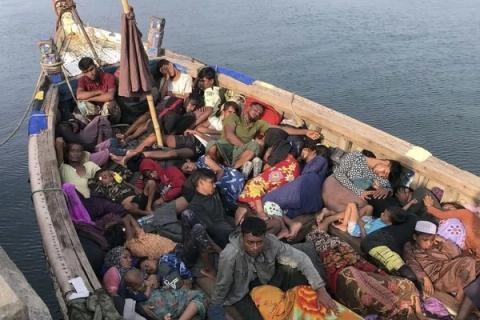
Special Investigative Report: The 2026 Andaman Sea Tragedy and the Deepening Global Maritime Crisis of the Rohingya
The Rohingya maritime crisis has escalated further with the tragic sinking of the Malaysia-bound vessel Tanjina Sultana near the Andaman Islands on 9 April 2026. The vessel carried an estimated 250–280 passengers, predominantly Rohingya refugees and Bangladeshi nationals fleeing prolonged displacement and insecurity in search of safety and livelihood opportunities. Only nine survivors have been confirmed, with over 270 individuals presumed dead. This tragedy highlights a continuing pattern of preventable maritime disasters driven by forced displacement, human trafficking networks, and the absence of effective regional search-and-rescue and refugee protection mechanisms. It underscores the urgent need for coordinated international action to address the root causes of Rohingya displacement and prevent further loss of life in the Bay of Bengal and Andaman Sea.
Latest news

AARA Alleges 51 Rohingya Civilians Detained, Elderly Man Killed in Rathedaung Township by Militant Arakan Army (AA)
Rohingya villagers face urgent concerns over a reported deadline imposed by the militant Arakan Army (AA) to leave their homes by October 17, 2026, raising fears of further displacement and loss of shelter.
1,500 Myanmar Nationals Deported from Malaysia Aboard Junta Warships Amid Airstrike Horror
Malaysia has begun deporting around 1,500 Myanmar nationals despite ongoing conflict, forced conscription risks, and warnings that safe and dignified return remains impossible.
August 25 and the Hindu Massacre Narrative: How the Arakan Army Is Shifting Blame Toward Rohingya and ARSA
The article examines how the Arakan Army's August 25, 2026 Hindu commemoration presents the 2017 Hindu massacre as an ARSA crime, raising questions over efforts to shift blame onto Rohingya and reshape the history of the Rohingya genocide.